Showing posts with label design. Show all posts

Sunday, August 30

Signs that Autumn is Just Around the Corner: Critters, Sedums & Locks

A turtle made of found objects soldered together by a friend; my cracked pot of hens & chicks seemed the perfect thing to slip into the wheel to complete his shell. See the orange pyracantha berries--already!--in sprays behind him?

I love autumn; it's my favorite season of the year, from the rich smells of decaying, earthy leaves and acrid, smoky bonfires to the glorious last blazes of color in the garden. Once the calendar hits August, I usually start thinking fall. I look forward to pulling out sweaters for brisk walks, plan for a visit down to the local apple orchard, and vigorously rid the house of summer's whirlwind mess the way that most people do spring cleaning months earlier.

But this year... well this year, I'm just not ready yet for fall! Maybe that's because I've been so busy (I made only 19 posts in all of 2009 so far? Yikes!) or maybe it has more to do with the fact that summer seems to have forgotten us this year. Either way, the signs of an impending autumn are undeniable... and I'm not particularly happy about finding a lot of them in my garden this weekend.


A ladybug by the same friend, made out of an old pipe cap and some other spare parts. I am seeing less ladybugs, and many more grasshoppers and other "late summer" bugs, in the garden these days.

For one thing, the 'Matrona' sedum that I love in every other stage but bloom... is blooming. I know that many people have asked in the comments about why I don't keep it from blooming, or replace it with something else. Two reasons: 1) I love the dried flowerheads. 2) The bees love the blooms!

I tried to count the bees on one of my two 'Matrona' plants today, and I was up in the 30s before I lost track of the number!

My summer-flowering sedums, like 'Fuldaglut,' 'Red Dragon,' and 'Voodoo' are all spent. Some are coloring up nicely, and still look full, but the ones that get a bit of shade--like the one below--start to look scraggly at this time of the year:


A couple of sedums are still in bud, though. Here's a variegated (unnamed, bought at a plant sale, but probably sedum alboroseum) one that prefers a bit of shade:

Sedum alboroseum (I think) nestled in with horehound at the base of sorghastrum nutens 'Sioux Blue'

And here's the sedum that I showed in my bloom day post, still nestled up against the warm brown of the nearby rock:

Sedum cauticola 'Lidakense'

By the way, if I ever do get rid of 'Matrona' it will be to replace them with more of this wonderful sedum that I bought last year from Plant Delights as 'Hab Gray' sedum telephium:

Sedum telephium (bought as 'Hab Gray') with a 'Sky Pencil' Japanese holly, red cabbage and blue fescue in the background

I'm kind of convinced that I have something different, though, because Tony Avent's notes on 'Hab Gray' say that you can expect "clusters of pink flowers"... and these are more of a yellow flower. That's perfect for me, so I'm not complaining! Also notice in the photo above how the flower buds continue all the way down the stems--very nice.

And as if that wasn't quite enough, check this out:

'Maybe Hab Gray' (as I think of it) sprouting up amongst the cutback stalks of drumstick allium

Awww... it's a little baby! In fact, I have at least 6 of these little guys sprouting up within 3-4 feet of my 'Hab Gray,' and that's fine with me. I'll be transplanting a few of them to various spots around the Lock Garden next spring, assuming they overwinter okay. (They're so little, and none of them will hurt anything where they are now, that I'm leaving them alone until spring.)

Speaking of the Lock Garden, I finally got it weeded, mulched and cleaned up. That's another sign that autumn is just around the corner--I always save this area for last, since very few edibles are grown here and the plants that do reside in "the locks" are tough cookies. Some areas are filling in very nicely already:

Sedum sieboldii, 'Metallica Crispa' ajuga, silene, 3 kinds of thyme, a self-seeded blue fescue and some random baptisia foliage in the lock garden.


A close-up of the sedum, silene, ajuga, and thyme--which is the beautiful 'Clear Gold' from Mulberry Creek--meshing together underneath one of the metal industrial shelves that serve as "bridges."

A few of the plants, like this lavender thyme, were a little too happy and needed to be cut wayyyy back. You can probably tell by the way his branches are draped that I chopped about half of the plant out toward the bottom of the lock:


Cutting back thyme (and other herbs) is always an enjoyable job, but this garden will need some "real" work within the next year, though. Where the clumpier sedums reside, the sides of the locks have caved in a bit, burying some of the stone that I culled (with permission) from work) to line the lock. Their roots aren't vigorous enough to hold the soil in place the way the roots of the thyme and creeping sedums do:


And I still have some framing and pebbling (technical term... ;) to do under the shelves that are either fully or partly resting on the ground. Here's one of the frames--made from cedar, and filled in with pebbles and a small sedum album that I love and let wander a bit--that I built last year:


That frame is a simple one, so the 2-3 identical ones that I need to make for the land part of the pathway should be easy. The shelves that partly hover above the ground will not be so easy. I will have to artfully construct two separate boxes--one for each end--for shelves like these:

Two of the "bridges" over locks in the Lock Garden that will need box ends to support them. The bridge in the foreground is over the sedum/silene/thyme/ajuga combo shown above. That's part of my asparagus bed (which is beneath a small 'Himrod White' grape arbor) falling onto the pathway on the left, and self-seeded blue fescues on the right. The second bridge goes over two different types of blue-leaf sedums.

I imagine that I will either need to shore up the end of the frame that abuts the plants in the lock with stone (or maybe a full plank of cedar?) before I can pebble them, to make sure that the pebbles stay where I want. It will definitely be an engineering job, but once the frames and pebbles are in place they will stay there for a long time... only the blue shelves get lifted off of the frames and stored in the garage for the winter.

I'm trying not to panic just thinking about how much I still want to get done in the garden this year--not to mention the need to finish my fence painting, too! And I don't have very much time.... after all, autumn appears to be just around the corner. :(

Thursday, January 24

Snow Reveal


We've been pretty lucky this winter so far; even during periods of cold temperatures, we have had pretty good snow cover. I like to feel as though Ma Nature has tucked in my plants with a layer of white, fluffy insulation to help keep them cozy in the ground.

The other nice thing about the snow is that it reveals things that you may not otherwise know or see. For example, these footprints lead directly from my mailbox to the neighbor's, right through my garden!!!

Now, I know that the snow is hiding a lot of my plants, and that others have died back to the ground entirely, but still... only someone who wants to pretend that they aren't walking through a garden could mistake this area for a lawn. And since I do not have a new mailperson, she knows what this looks like during the rest of the year. Grr.

Snow also reveals the "bones" of the garden, including the branching structure of some shrubs that are otherwise hidden beneath a leafy canopy.

This is my doublefile viburnum, and between its horizontal branching habit, the beautiful, leathery green of its leaves, and the way it looks against the snow... well, so far those pluses have outweighed the negative of it being a moisture-sensitive plant.

I am looking for a more drought-tolerant replacement for it, but until I find something to fill is rather large shoes in terms of year-round interest and... well, handsomeness, here it remains. (Anyone want to weigh in on the merits of replacing it with a larger oakleaf hydrangea? I have a dwarf one planted approx. 14ft away from this spot, and can't figure out if I would really like or really hate having two oakleafs in the same bed.)

The snow also reveals what a distressingly messy gardener I can be. I'm not terribly apologetic about this, to be honest, because I love seeing seedheads and frost-frazzled leaves from plants like yarrow, echinacea, and of course all of the grasses as well.

I may regret my decision not to clean up a few prolific self-seeders, like bronze fennel, atriplex hortensis, 'Hopi Red Dye' amaranth, and these Northern Sea Oats... but I figure that doing a spring cleanup, and weeding out or transplanting a bunch of seedlings, will give me some "light duty" projects to do in a few months, when I'm itching to really dig in the dirt but know that I shouldn't!

Last but not least, when the snow has provided a ground of white for your plants, and flashy annual color is a distant memory, you can sometimes better assess your overall design where perennials and shrubs are concerned. I've always struggled a bit with identifying my own garden design style, but it's probably technically identified as "eclectic." That said, I like the way that Craig at Ellis Hollow described it to me not too long ago: controlled wildness.

I've been taking several looks at my new front yard garden this winter, and think that I have figured out a few things that I want to tweak in the coming year. (You can see what it looked like this fall, when newly planted, here.)

Right now, this garden seems to have a little too much "wildness," and not quite enough of it is "controlled!" A couple of the more formal elements that I had introduced, like planting the Japanese hollies in a row, and echoing that with a row of 'Hameln' pennisetum in the middle of the garden (above the golden yucca) really stand out now as places for your eye to rest.

I think that providing another formal but modern element, and providing the eye another place to rest, answers my question of what to do in the 18-inch strip in the foreground of this picture, in front of the yucca, caryopteris, and euphorbia.

In fact, I think that what I need is to have a straight line of shorter grasses there. Much as I have been enamored of my carex buchanii (left) of late, I think that something unfussy, in a medium green would be best. Something that is not usually used in a formal way. Maybe some prairie dropseed--which I've been trying to find a place for in my garden anyway--or maybe the 'Hameln,' but more of it, with the prairie dropseed planted in its current place instead.

Whatever the actual plant, I think that making this tweak will help tame this area and give it a little structure. Unless, of course, further viewing of the snowy pictures reveals another idea for me!

Thursday, July 26

The Bitty Garden

I admit that I have a little crush--the harmless schoolgirl kind--on Frank Ronan. The columns that he writes for the back page of Gardens Illustrated often leave my wheels spinning in circles... and I will always have a soft spot for a man who makes me think. In the June issue, Frank related the experience of having an (unidentified) expert visit his garden. As this guru walked around, one of his compliments sent Frank into a tailspin. To his horror, he realized that what the gentleman meant was that his garden was bitty. Bitty. You know, "A little bit of this, a little bit of that..."

Well, reading Frank's words put me into a tailspin of my own. Could my garden be bitty, too? Even thinking the word made me irritated because of its stingy connotations, but I couldn't shake the feeling that Frank had put his finger on the reason I have been largely unsatisfied with some areas of my yard. And why "thickly planted" wasn't always translating to "lush and generous" as I had wanted.

For the past couple of years, since moving to a small urban plot, my aim had been high contrast. I figured that I needed to maximize the impact of every individual plant in the yard by showing off the leaf texture, habit, and flowers of each against a foil. Some plants were repeated throughout the garden in an effort to achieve some sense of rhythm and continuity, but always they were surrounded with different, contrasting colors and textures.

After chewing on its implications for several weeks, I reread Frank's article last night and then walked around my yard. My dawning understanding that combining areas of high contrast and areas of low contrast are... well, a good contrast... made me want to make at least a few minor adjustments yet this year. I tried to think about it in terms of allowing some plant combinations to be the main attraction, and making others lead your eye to that painting--or at least serve as a complimentary mat around it.

One of the first things that I did was a relatively easy fix. The retaining block wall that I had built planting pockets into this spring had a jumble of things planted on its upper edge. The gray creeping germander and the wooly thyme are at least the same shade of gray-blue, but there was also a green sedum between the little bluestem grasses and a cascading rosemary smack dab in the middle of the wall. These greens interrupted the repetition and line of the brick wall and just kind of felt awkward and jumbled.

So I relocated the rosemary and the sedum, moved the germander over in front of the little bluestem in spit of my concerns about too much of the same color there, and filled in the rest of the space with more wooly thyme. The second picture was taken when I was midway through the project, but I think you can already tell that it is going to be an improvement.

Then I went over to the driveway bed, which I had optimistically been thinking of as "a funky riot of color, Pacific Northwest style." Yup. Definitely lots of bitty going on there. A solitary 'Brise d'Anjou' jacob's ladder was moved next to a scaly Brackler fern to echo the leaf shape, and was thus made to seem more "unique" and less "orphan." Two of my cimicifugas were sited about three feet apart, but the third was located about 8 feet down the same bed... now all three are living more closely together, with room in between for a couple of large leaf plants (maybe green brunnera or hardy begonia) of the same kind to tie them together.

As the sun started to set, I quickly pulled out all of my 'Whiskey' wax begonias for one last fix. Instead of planting them in drifts or clumps, I had used them singly to fill in empty spaces. Eek. This might have worked better with a spreading plant like petunias that would eventually give the impression of groundcover, but with wax begonias it just made the garden look... well, you know. So after they were all out and laid neatly in a row on the driveway, I went back through and found a half dozen places were I could clump 3 or 4 of them together, then replanted. You can see three of those clumps next to the fern and polemonium combination in the third picture.

There are a few more things to move, and a few more things to think about moving before I actually go at it again with a shovel. There may be things that I decide not to move at all, to keep some repetition in the garden and make sure I don't lose all of the contrast. But I have a good feeling that my efforts thus far--and just keeping in mind that I want to avoid being bitty--are going to help the garden look much better in the long run. It may take another 3 or 4 years and quite a few more mistakes, but I hope to get there.

Tuesday, July 24

Corporate Landscaping

Generally, when I think of "corporate" or "public" landscaping I think rows of Japanese barberry and burning bushes, with tons of daylilies--mostly Stella D'Oro--stuffed in for summer color. Recently, some places have gone a bit trendier and started to mix in ornamental grasses as well. But a few places I haunt in the Cleveland area have really put some thought and imagination into their landscaping, and I admit to being inspired.

The city of Brecksville, which is near where I work, does interesting containers like this one. Orange celosia, Non-Stop begonias, variegated geraniums, and orange-edged acalypha stuff this container full of warm color. Its two smaller companion pots feature a bronze cordyline, more of the celosia, and silver trailing lotus vine. I like how the fine textures of the lotus vine and the asparagus fern used as filler in the larger center pot echo each other nicely.

It's not just containers that the Brecksville public works department does well, either. In their town square they have annual beds featuring dark-leaf cannas paired with ornamental grasses, bronze- and purple-leaf dahlias, and even "lowly" marigolds and salvias. Similar combinations grace the ends of long berm beds that split several 4 lane roads through town. In between the annual beds these berms still show 3+ seasons of color thanks to a low-maintenance mix of euphorbias, Russian sage, spring bulbs and various grasses.

Another place that does annual color well is Crocker Park, and upscale "shopping community" in Westlake. Some of their great containers include large bronze-glazed ceramics planted with just one type of orange- and yellow-flecked coleus, and huge pots with forest-worthy stands of dark-leaf cannas underplanted with enough cascading pineapple mint to keep me in tea for a decade.

The adjacent (and older) Promenade shopping center has long boasted wonderful landscaping in small beds that had been inset in the sidewalks, as well as a large burst of color in the fountain area that separates my favorite Borders bookstore from a large cineplex. Hardy hibiscus, various roses, and large mugo pines have formed the backbones of this area for the past few years, but the annuals really make the area special during the summer months. (You can click on any of the pictures to see details.)

In the first picture you see the hibiscus tucked in amongst a red-flowering, red-leaf celosia and a red-and-yellow flowering lantana. The silvery carpet underneath it is 'Silver Falls' dichondra. In the second picture, you see another bed with hibiscus and red celosia, but this one includes white geraniums, dark purple angelonia, and the refreshing combination of 'Cerveza 'n Lime' plectranthus and blue fescue.


A nearby bed goes more for the cool end of the color wheel with blue fescues, bronze cordyline, white petunias, Mexican heather, some kind of dark purple alternanthera, yellow-variegated grass, and 'Black Pearl' ornamental pepper. The black-eyed susan appears to be a self-seeded accident at first glance, but it adds some much-needed height there and a great leaf contrast as well so I believe that it was an intentional addition.

See the yellow coleus edging the separate bed further back in picture two? It compliments the yellows and purples in this front bed so nicely, and also leads your eye past the edge of the bed and over the sidewalk into the next area of color. That's another thing they do particularly well in this maze of beds around the fountain.

I am learning a few tricks from both of these public landscaping examples. From Brecksville, I am learning how to work with annuals that have interesting leaves and artfully combine them. From Crocker Park, I am learning to better use annuals to fill in my regular planting beds. I don't really know why, but I tend to keep my annual color in containers instead of putting them directly in the ground... now I see what I've been missing!

And from both, I'm getting ideas on how better to echo the colors and textures of key plants to make for a cohesive look in the garden. Hopefully learning these lessons will help keep my garden from being too "bitty"... but I'll have more thoughts to share on that score tomorrow.

Thursday, January 4

The Best Laid Plans...


You might remember me bragging about how I wrested an overgrown "dwarf" willow tree out of the ground with my bare hands (okay, and a pruning saw) this past summer. After it met its deserved end, I settled a newly purchased 'Diablo' ninebark in its place.

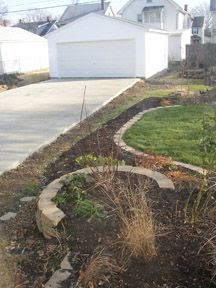
Between then and now, the house next door was sold. I am going to be putting up a wooden privacy fence bewteen my house and this lot in the spring, so I didn't worry too much about what their plans would be for their backyard. I knew that the house had been slow to sell in part because there was no garage or other covered parking, but I figured that the fence would take care of hiding whatever was built in the backyard.

Well... maybe not. This shot was taken out of my large picture window in the dining room. In the foreground you see the aforementioned ninebark, snuggled within the confines of a circle of retaining wall block alongside some hellebores and ajuga.

When I am in the backyard at ground level, a 6ft. tall fence will provide plenty of privacy. When looking out my picture window, however, the stark white garage will be very distracting as it peeks over the fence. And peek over the fence it will--see the grey fence at the back of my lot for a height comparison. That fence is 6ft. tall painted spruce stockade.

Luckily, all of this happened before the ninebark had much time to settle in. It will get switched this spring with the 'Northstar' dwarf cherry tree that is currently residing midyard and has a much taller (to 10ft.) and more upright form than the ninebark. It won't help as much during the winter, but during the colder months of the year I spend more time looking to the right, at my birdfeeder, anyway.

Oh, and I forgot to mention the best part about the whole construction deal. The new owners are actually just flipping the house, and they have offered me the HUGE rock that was in their backyard as compensation for tearing up some of my grass while they put in the driveway and garage. The grass was frankly marked for death anyway, and I was trying to figure out a way to ask them if I could buy the rock off of them... so I am thinking that this is working out pretty well for me all around!