Sunday, February 18

Overview: Cleveland Home & Garden Show


The Cleveland Home & Garden Show is held each year in early February at the IX Center--a huge soulless warehouse of a building. I can never decide whether the display gardens breathe life into its metal frame or whether the natural beauty suffers in the cavernous, badly lit space. Probably a little of both. The timing is right, though, for plants and gardens to delight and inspire those who are weary of the whitish greyish brownish monotony of a Northeast Ohio winter.

This year, the main theme for the gardens was "Ireland," with a secondary theme of "green." A modern and environmentally friendly interpretation of an Irish castle was the centerpiece of the show. I'm not sure what I expected from the castle, but I wish that more information had been made available on the green building techniques and how they could be adapted by homeowners to improve our own "castles."

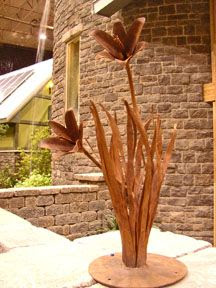
The interior of the castle was mostly disappointing. The two bright spots were the works from local artists featured throughout the house and the gorgeous kitchen cabinetry. The exterior was beautiful, though, and combined form and function very well. The first picture features a corten steel sculpture of lilies that graced the front patio. (I loved that--I'm a sucker for corten and other rusty metals.) Beyond the sculpture you can see the solar panels on the garage roof and a small waterfall that spills into the "moat" water feature.
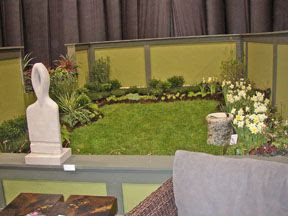
The second picture shows a green roof that was visible from a second story walkway. The grass courtyard surrounded by square planting beds is pretty, but I couldn't help but think there are more practical planting options than grass when you are building a green roof. I also couldn't see where the excess water from the roof drained, even though it was obviously built on a slant--I suppose that these are some technical details that aren't worth worrying about when you're building a short-term display, though.
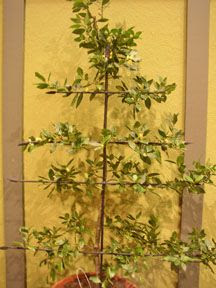
Next to the doorway that led out to the green roof were a pair of espaliered bay laurels that made my jaw drop. I have been checking out my two bay plants every since, wondering why I never thought to prune them into interesting shapes!

The castle was the first thing we walked through when we arrived; after that we moved on to the display gardens. Twentysome gardens were created by various landscape professionals and garden centers, most of them "in tribute to" or "sponsored by" (I can't quite figure out how that works) a local media talent.

The first display garden that we came to after exiting the castle was not quite like the others--there were no obvious signs with TV station logos and glossy, smiling mug shots at its entrance. It was simply a ring of standing stones surrounded by a waist-high berm of grass. A flat stone walkway encircled the standing stones, and at the center of the stone circle was a misty bog filled with heaths, heathers, orchids, ferns and moss. It was delightfully mysterious, a Druidic ruin brought into the modern day.

Most of the rest of the display gardens were not so much in keeping with the "Ireland" theme. Even when they were lovely, they did not quite transport you to anyplace other than an expensively well-done backyard... and I really wanted to be transported.

Although I was not very enthusiastic about the display gardens overall, some did have interesting features and ideas. I have a few pictures to show: Some great use of stone, how much interest you can create with just green and brown in a composition, etc. I also found an interesting way to use rusty metal in a practical application in my own garden!

All of that must wait for another day, however. I am never good at being concise and I'm sure that I have gone on quite long enough for one post. In the meantime, you should be able to click on any one of these pictures to see it in a larger size, if you want to take a closer look.

Wednesday, February 7

Winter Break


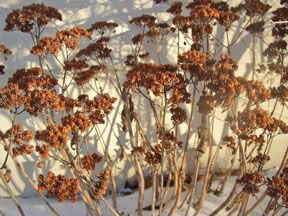
I adore sedum 'Matrona' in the winter. Its deep brownish hue is the one shade of pink that I feel capable of handling in my garden. If only they would emerge this color, they would be a perfect plant for me... but I endure the cotton candy phase, knowing that this quiet beauty awaits me.


Just as plants need a break in the winter to rest and regroup, people sometimes need the same. I have been working every weekend, planning my spring garden, cleaning and decluttering my house, worrying about how to pay for repairs should my pipes freeze... and trying to figure out a few of life's great mysteries at the same time.

I usually thrive on stress like this, but right now I just feel taut and brittle. I am being rather shortsighted and self-absorbed in comments posted on other blogs, posts shared here, and even in one-on-one conversations with my friends. I am definitely overdue for a little hibernation. It's time to take a step back, send my energy back into my roots, and relax.

I'll be back in a week or two, and will post pictures and a review of the Cleveland Home & Flower show when I return. I am heading there tomorrow (my birthday--I officially turn 31 at 4:45am) which will be just my second day off since New Year's Day. I am looking forward to getting a few ideas for next year's garden... and some much-needed plant therapy as well.

Tuesday, February 6

Naked Pyracantha

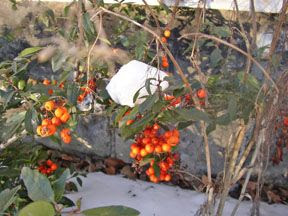
Notice anything different about my pyracantha today? Scroll down to the pictures I took on Sunday morning and compare...

Yup, my lovely orange berries are gone. I noticed their absence as I walked toward the house after parking the car in the garage this afternoon. The funny thing is... I think that I know who ate them!

As I left for work this morning, my presence caused a robin to run out into the yard from the vicinity of the pyracantha. I noticed him because it's pretty unusual to see a robin hanging out in Cleveland in early February, especially when the temperatures are in the single digits.

I would guess that he's eating well here, though, because he was rather portly, even for a robin. I will be checking some of the other berried shrubs that I see on my daily walks with the dog... it will be interesting to see whether he was just passing through or whether he thoroughly made the rounds in my neighborhood.

Monday, February 5

Pineleaf Rhododendron?


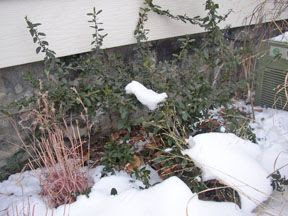
Okay, I admit it. The title of this post was a geeky attempt at bad botany humor. As I observed my poor cold rhodie do its best impersonation of a needled evergreen, the words Rhododendron Pinifolius popped into my head. I giggled at the thought of making a tongue-in-cheek post to describe the rare pineleaf rhododendron, only observed on special days in the coldest of winters... yes, I'm sure that the cold was getting to me!

It amazes me that plants have such great coping mechanisms. It looks unhappy, but what the rhodie is doing is curling its leaves to keep the moisture from leaving through tiny vents in the undersides. It was -1 degree outside when I took all of these pictures yesterday morning. This morning I got up at the same time but was greeted by -4 degrees instead. I couldn't tell if the rhodie leaves were more tightly curled this morning or if I was just expecting them to be, though.

I don't really mind the cold itself, even if you factor in the wind chill. The big downside is that the pipes in my upstairs bathroom tend to freeze when it's below 12 degrees unless I leave my sink faucet drip. Friday night I discovered the hard way that when temps drop below 5 degrees, the sink doesn't quite move enough water to prevent the pipe freeze.

The pipes thawed on Saturday, but I have since had to leave the bathtub faucet drip as well to ensure the pipes don't freeze again and burst. My February heating bill is going to be bad, and my water bill is not going to be a whole lot of fun, either. I'm so appalled at being forced to waste so much water that I am already saving to tear down a few plaster walls this spring (where certain plumbing pipes reside) and replace them with insulation and drywall. Obviously I will not be going out for a steak dinner any time soon.

On the bright side, I've been able to drink in a lot of beauty to help sustain me through the frigid cold. With brittle sunny skies and the lovely crunch of snow underfoot, NE Ohio has never looked more beautiful to me as it does this winter.

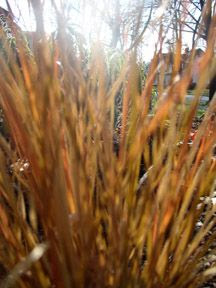
It may just be my imagination but the cold seems to tinge the snow and even the air with a slightly blue hue, which makes orange pyracantha berries, the deep rose of papery sedum flowerheads, and even the slightly pink hue of dried little bluestem blades glow like the jewels of the winter garden.

Wednesday, January 31

Gardening and Artistry: Part I

Recently, a posting on As the Garden Grows asked this question: Why do we garden? As I read, I mentally ticked off Tricia's points. Wanted to grow my own food... check. Enjoy the relaxation... check. There was something missing in her list, though. Something that motivated me but had not been named. As I tossed and turned last night, it finally came to me. I had to admit that part of the reason that I garden is to indulge my artistic ego.

In fact, I dare to suggest that all gardeners who grow things with any consideration at all for aesthetics are artists at heart. Some of my fellow garden bloggers may already be disagreeing with me, or at least shaking their heads and saying, "Not me--I'm no artist," but wait. I just did a search for quotes with the subject of "artist" in one of my favorite quote databases, and found many quotes that seem to back up my theory. So let's explore a few ideas before you tell me that I'm wrong:

"All civilation and culture are the results of the creative imagination or artist quality in man. The artist... makes life more interesting or beautiful, more understandable or mysterious... more wonderful." - George Bellows

When I first started gardening, I was attracted to the idea of naturalistic gardens. I am very reverent about the beauty of nature, and also liked the idea of putting in plants that were well-suited to their surroundings and thus would not need much babying. In reality, I found "naturalistic" planting to be a huge letdown, and also somewhat of an inherent lie.

The truth is, when we garden, we are not randomly and naturalistically planting. We weed out unwanted plants. We plan for aesthetically beautiful combinations and appreciate the occasional happy accidents. I believe that Piet Oudolf and Noel Kingsbury expressed my own feelings best in Planting Design: Gardens in Time and Space: "Strictly speaking, nothing that is made by people can be truly natural, and since gardens (unless they are simply enclosures of wild landscapes) are by definition human artefacts, it is perhaps misleading to speak of natural gardens."

Gardeners make plantings that are more interesting, more beautiful, more understandable, more mysterious, Therefore, they are artists.

"He who works with his hands is a laborer. He who works with his hands and his head is a craftsman. He who works with his hands and his head and his heart is an artist." - Francis of Assisi

All gardeners work with their hands, sometimes with the aid of a tool or with the protection of a glove but always with their hands. We use our heads, too, in planning out the sizes of beds or the spacing of annuals. And in diagnosing plant diseases and sussing out whether too much rain or too little sunshine is the cause of a plant's lackluster performance in a certain spot.

And gardeners definitely use their hearts. Some plants we keep in the garden simply because they make us smile, or because they remind us of our roots or a certain special person. Sometimes our gardens break our hearts, whether ice storms cause tree limbs to fall or whether our own mistakes cause the untimely demise of a favorite plant.

"Children, like animals, use all their senses to discover the world. Then artists come along and discover it the same way all over again." - Eudora Welty

I see this childlike amazement at the natural world over and over again in various garden blog posts. Lisa over at Millertime constantly amuses me with posts that express her delight in everything from vermicomposting to raising fungus. Don (who I think of as Iowa Garden Boy) takes beautiful pictures of snowdrops and snow-mired winter grasses that non-gardeners would walk right by... and he posts them, too, for all of the rest of us to appreciate. And so many other garden bloggers experience and share their own childlike amazement in other ways as well.

So, have I proven my case beyond a reasonable doubt? No court of law would think so. But I'm more interested in what my fellow artists--er, gardeners--think.

Do you consider yourself an artist? Do you simply try to keep your flower combinations from clashing or are you driven to create particularly dynamic and exciting combinations?

Do you copy the designs of the "old masters" like Vita Sackville-West, Gertrude Jekyll, and Roberto Burle Marx? Do you subscribe to a certain style of design, like English borders or cottage gardening, or do you prefer to be eclectic?

Do you find yourself tending to stay with one type of plant (perennials, vegetables, shrubs, annuals) or are you fully into mixing your artistic media?

Do any of these art analogies work for you--in your head and in your heart? Or do you think I must have delusions of grandeur to think of myself as an artist? I would love to hear your thoughts, either way.