Sunday, March 11

The Big Thaw


Today was a gorgeous late winter day: Mid 40s, blue skies, sunshine. The snow that did not melt yesterday had disappeared by the time I got home from work today, save the large drift by my back fence. It is still a good 15 inches tall, mostly because that area is so dark in winter due to the severe angle of the sun.

I grabbed my camera and went out to see what the thaw would reveal about my plants. Here was the bergenia, flat as a pancake on Friday when I first saw it but slowly recovering from the inner to the outer leaves. It's such a great color that even when it looks terrible like this, it still looks good to me.

And the small sprouts of variegated Jacob's Ladder that had bravely emerged in early January are still there, looking none the worse for their snowy hibernation. Skeletons of bronze fennel are still amazingly upright by the side of the porch, and the silver leaves of sage are glowing beside the reddish leaf buds of 'Voodoo' sedum.

The plant spotting that I was most excited about eluded me photographically... but all three of my purple clover (trifolium repens var. atropurpureum) are coming back! I think that they must have heard me grumble that I'd tried them for two years now and I wasn't going to replant them in 2007. Who says threats don't work on plants?!

Thanks to everyone who has commented on the previous post about gardening phases. I haven't had time to get mine all together yet, but I also wanted to give more people time to chime in before I post. Reading your comments has been lots of fun...

Tuesday, March 6

Going Through a Phase?

As far as checking gardening forums goes, I do it sporadically. I find that blogs are usually much more in-depth in the way that I crave. The other day, though, I had finished checking all of the blogs I like via Garden Voices, and decided to visit their forums. On the Perennials forum, a poster with the username "Aachenelf" (who I wish had a blog of his own, by the way) had posed an interesting question: "Have you gone through plant or gardening phases?"

I'm a relative newbie in the world of gardening, so I was surprised to realize that I have already gone through quite a few phases. I'll post some more about my phases in a few days, but I wanted to pose the same question to all of you first.

Any gardening phases that you've gone through? An expensive addiction to Japanese maples? A tireless quest for the perfect foxglove? The quest to create the perfect kitchen garden, worthy of a French chateau? The mistaken belief that you really needed to grow 37 different kinds of tomatoes--and that you would eat or can them all?

Come on, now... this one will be fun. Let's all 'Fess Up!

Friday, February 23

Cleveland Home & Garden Show: Getting Garden Ideas


As was discussed in comments on an earlier post, the builders of these temporary display gardens aim to win design and installation contracts--not to give ideas to the average DIY gardener. I do not think that inspiring gardeners and convincing non-gardeners to hire you are mutually exclusive, however.

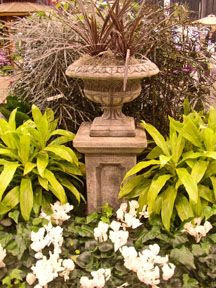
It would stand to reason that good design is attractive to both camps. A green, bronze and white color scheme may not be your thing, but the strength of the foliage arrangement around the urn in the first picture might catch your eye anyway. Those gardens that are especially strong design-wise are often the ones that stay in your mind long after the show has been disassembled.
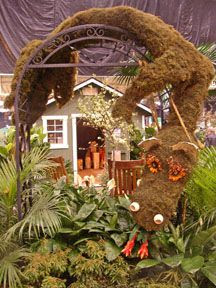
Interesting elements can simply be amusing, too. Perhaps you wouldn't want to have this moss monster greet your garden visitors, but his mushroom cap nostrils and orange sunflower eyes probably made you smile and take a closer look. These first two vignettes came not from a landscaper's display garden but from that of a large local garden center chain. Might they feel more comfortable taking risks at shows like this than a landscape designer does?

In spite of my enjoyment of certain elements within the displays, my reaction was mostly: "Nice... but Not In My Garden." There was only one garden to which I kept returning. At first glance it looks simple, and feels a little quiet--not my usual style at all. So I studied it, trying to figure out just what it was that I liked so much.

Much thought had gone into the placement of sight lines within this display. The garden had a main diagonal axis highlighted by metal and stone pathways. The garden structure boasted an open, pergola-style roof and a flagstone floor. The walls were rigid sheets of pierced metal within wooden frames, and all of these panels were attached to the structure with rolling, barn-door-style hinges. The structure was nestled within an interpretation of rocky, open woodland.

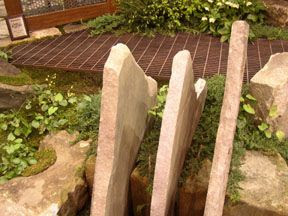
I finally decided that there were actually three things about this garden that intrigued me. The most obvious one was the clever use of metal. Metal generally adds visual weight in gardens, but the spaces in the metal elements that the designer chose mitigate that heaviness here. Instead, the metal forms a nice bridge between the dense rocks and the soft plantings of epimediums, moss, hellebores and junipers. The pierced panels add a sense of mystery to the garden views that they blur. The rusted grate provides a sturdy path to the structure over uneven ground without completely hiding the terrain beneath it.
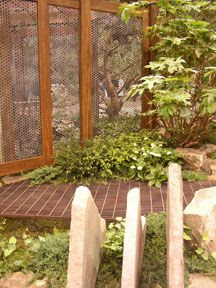
The second element I identified was the skillful use of line and repetition. The grate is set in the ground at an intriguing angle--not the expected one, perpendicular to the structure, but one that makes more visual sense because it follows the garden axis. The bars within the grate line up with the three feature stones, compliment the lines of the structure, and even lead your eye beyond the structure to the flagstone path beyond. (See the first picture of this garden for an illustration of that last point.)

The third element of interest is more of an idea or a statement. At first glance, this looks like a very naturalistic garden with browns, greens, rocks... but consider that the brown of the path is an industrial floor grate, and the most eye-catching rocks have been cut very deliberately and set on edge, evenly spaced in a very deliberate way. Then see that there are plants sprawling over the metal grate and junipers creeping through the stone trio--nature is trying to take the space back. I appreciate this illustration of the tension between the natural and manmade worlds that so many modern gardeners feel instinctively.
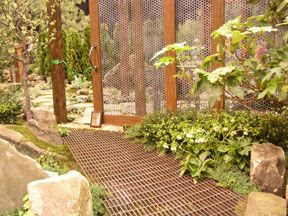
If you have not yet guessed, the grate is the metal element that I am planning to use in my own garden. I am enamored of it for all of the reasons stated above, and also for two others: 1) As an elevated pathway, it will afford me the rare opportunity to incorporate an "elevation change" in my tiny, flat lot. 2) Planting the area below the grate with thymes and rocks (I don't have the moisture for moss) will definitely create a more interesting walk to the Japanese rock garden. Hopefully it will also slow people down as they look underfoot.

I realize that I probably will be hard-pressed to find such a heavy industrial castoff in my neighborhood on trash day. So this spring I'll have to find out where the nearest salvage yards are located. And that could be the start of yet another very dangerous hobby...

Michael Pollen and Kitchen Gardeners International


Food is one of the main reasons I began to garden. I wanted fresh herbs but didn't want to pay $5 for a wilted bundle of cilantro in the grocery store. I loved eating real, flavorful fresh veggies and fruit. Not the medium red, perfectly round orbs that fit someone's image of what a tomato should look like but didn't come anywhere close to the way it should taste.

In the past few years, I have also been working on living more deliberately. Eschewing things like big-screen TVs and the latest fashion trends, and concentrating instead on buying less stuff and spending more time with people who matter.

I have not yet crystallized my thoughts on how food buying fits into my feelings on how to live more responsibly, but I'm guessing that others are probably similarly confused by different issues. (Organic or Local? Frozen or Fresh?) If this topic interests you at all, this short article by Michael Pollen, originally published in the New York Times and reblogged on Kitchen Gardeners International, is definitely worth a few minutes of reading.

Wednesday, February 21

Cleveland Home & Garden Show: Display Gardens Overview


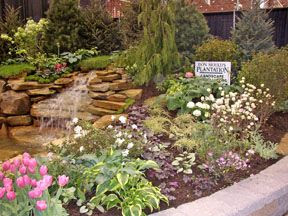
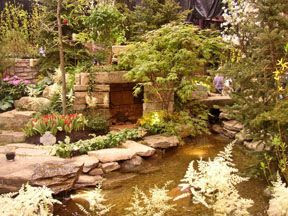
Water and stone seemed to be the common thread that wove together this year's display gardens... along with a distressing amount of reliance on the same color palette. I know that when you think of Ireland, fields of heaths and heathers in swaths of dusty pinks and purples may come to mind. But I simply cannot believe that those colors plus maybe a few white or soft yellow highlights are the only flower colors available in Ireland.

There was the odd glimpse of red: red tulips, an azalea that was blooming a little more crimson than cerise, etc. But the only garden that strayed from the general script was a charming little bright yellow cottage planted with an exhuberant mix of red-flowered begonias, dusky purple phormiums, elephant ears, and blue-flowered hydrangeas. Although it wasn't something I would normally like, seeing it was a visual relief!

But I digress. There were a number of interesting features within the gardens themselves. I loved this little pseudo greenhouse. I couldn't help but wonder whether I could incorporate something like this in my backyard, using some of my trashpicked windows.


Another take on the tradition of druidic standing stones... but this one is more like a campfire

This garden had an interesting little hidden cave by the side of a "stream"... it's hard to see inside, but there was a campfire set up inside. The case of Guiness bottles on the top of the cave was a little bit too much of pseudo-clever joke, though.

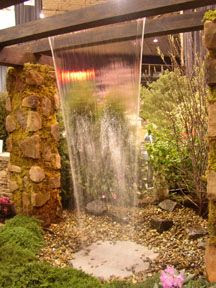
This sheet of falling water came out of a pipe hidden in the last beam of an arbor. The supporting columns were sheathed in rocks and fake moss.

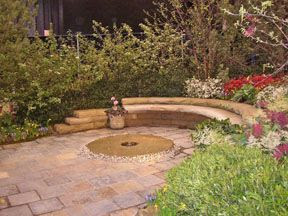
This little nook was my favorite water feature, I think. Water gurgled softly through the opening of the millstone. I appreciate how the stone bench seat echoes the curve:

I still have to share the pictures of my favorite display--and the idea I'm going to steal for incorporating metal in my garden this year. But I have made a resolution to shorten up my long-winded posts a little... so this is enough for now. (See, Hank? It wasn't all "smokey watery gateways to hell"... although I'm still grinning over that comment!)