It's Garden Bloggers' Bloom Day... and while there's nothing yet worth showing out in the garden, I have quite a few things that are still in bloom in the house: The passalong abutilon from Kylee, abutilon megapotanicum and dragonwing begonia (both in "dormancy"--ha!) in the attic, and some nameless rescued orchids with tiny red flowers. The peace lily and the jewel orchid are still going strong, too.
An embarrassment of flowering riches, really, for Cleveland in March. And yet I'm most excited about two newly discovered buds. The amaryllis that I blogged out in my previous post, and this:
That soon-to-be beauty is a bud on my Paphiopedilum Canticle x Macabre Pie--last shown here, in February's foliage follow-up, with its dead previous bloom stalk still intact. I picked it up this fall on clearance, as the last flower on the previous stalk was fading, so I never expected rebloom so soon. I can't wait to see it!
For a proper showing of actual spring beauties across the northern hemisphere--and maybe even some "fall" jewels from our friends south of the equator--visit Carol's March GBBD Roundup post at May Dreams Gardens.
Monday, March 15
Saturday, March 13
When Late Winter Feels Like Early Spring (and other Seasonal Wackiness)
It's been one of those weeks when the calendar says it's late winter, but your nose can smell an early spring. The quick snow melt over the past few days revealed a lot of interesting things in my neighborhood, like crocuses, matted grasses, and these hellebores:
Distressing to Miss Coco is the annual exposure of her numerous hidden "chewies" in the backyard. She collected 14 (!!!) of them near the corner of the house while I was cutting down grasses on Thursday, and has been systematically bringing them in the house one by one. Here's part of her outdoor collection, which is apparently being guarded from neighborhood doggie thieves by the her friend the turtle:
During my cleanup, I noticed that my tiny snowdrops have returned. These are the only ones that have ever grown for me, and I realize they look a little pitiful and lonely, but they still make me smile:
The new growth on some of my groundcover sedums definitely says "spring"... but the long shadows cast by the Russian sage in front of them are a reminder of winter:
In the house, the Amaryllis is even more confused than I am about the seasons:
This will be its THIRD time blooming without a dormancy break! I'm not even sure what to say about this one... I'm just steering clear of it and leaving it be, because it apparently is liking all of thisneglect wonderful, attentive care I've been giving it for the past year and a half.
Either that, or it simply likes to torture me. Don't be fooled by the close-up of the bud shown above... when this guy blooms, the flower is PINK. (Argh, lol.)
Hope everyone else is outside enjoying this great preview of spring, and maybe even getting your hands in the dirt a little bit, too!
Distressing to Miss Coco is the annual exposure of her numerous hidden "chewies" in the backyard. She collected 14 (!!!) of them near the corner of the house while I was cutting down grasses on Thursday, and has been systematically bringing them in the house one by one. Here's part of her outdoor collection, which is apparently being guarded from neighborhood doggie thieves by the her friend the turtle:
During my cleanup, I noticed that my tiny snowdrops have returned. These are the only ones that have ever grown for me, and I realize they look a little pitiful and lonely, but they still make me smile:
The new growth on some of my groundcover sedums definitely says "spring"... but the long shadows cast by the Russian sage in front of them are a reminder of winter:
In the house, the Amaryllis is even more confused than I am about the seasons:
This will be its THIRD time blooming without a dormancy break! I'm not even sure what to say about this one... I'm just steering clear of it and leaving it be, because it apparently is liking all of this
Either that, or it simply likes to torture me. Don't be fooled by the close-up of the bud shown above... when this guy blooms, the flower is PINK. (Argh, lol.)
Hope everyone else is outside enjoying this great preview of spring, and maybe even getting your hands in the dirt a little bit, too!
Saturday, March 6
On "Black" Plants
In art classes, I was always taught that "true black" does not actually exist in nature. Anything that the eye reads as black is really the darkest shade of blue, red, brown, green... and in general, I think that's probably true.
Take this begonia for example. In the harsh light of a flash photo, it looks fairly flat-black as a backdrop to the Meyer lemon buds:
But in more natural lighting, you can see the shades of green in the center of each leaf, and the purple tinge to the outer part of each leaf:
'Black Lace' and 'Black Beauty' elderberry leaves are also more of a deep purple:
'Hillside Black Beauty' bugbane (actaea, nee cimicifuga) definitely shows its true green beneath the "black," especially on the newer foliage:
"Black" tulips (I grow both 'Black Hero' and 'Queen of Night') are more of a deep, deep wine color. Here are two shots of "the Queen":
And here's one that shows how you can pop some color out of your "black" plants by placing them in the right spot. The orange heuchera underneath really warms up 'Black Hero':
Even my pooch is actually a dark, dark brown--her coat glints with hints of red when you see her in the sunshine, even though she looks inky black (with snowy white markings) here:
So why am I thinking all of these black thoughts lately? No, it's not winter depression, but something much more fun! Part of my birthday present from Steve this year was the book Black Plants: 75 Striking Choices for the Garden by Paul Bonine.
I don't remember oohing and aahing over this one within earshot of Steve, but apparently I made my desire known as I read through one of my newsletters from Timber Press. (You can go to their website and sign up if you want--Editor-in-Chief Tom Fischer's messages are great, and they let you know about different sales they offer. I just noticed that they're podcasting now, too, so I'm going to check that out this weekend.)
It wouldn't have been a far stretch for him to figure out that this would be a good gift for me, though. My love of interesting foliage (especially dark foliage!) is pretty well documented. Black Plants definitely feeds my dark foliage craving through its many pretty pictures--and I'm proud to be able to say that I already grow at least 16 of the dark beauties described within its pages! (Yikes, that's more than 20%!!!)
If you're looking for guidance about how to site these dramatic plants within your garden, however, you'll need to look elsewhere... it's short on design tips and tricks. But, hey, the drool factor is high. And you might just be so inspired by one of these gorgeous plants that you'll make a place for it to live, if you have to! But beware: As my garden can attest, these plants do have a true dark side: Plant one, and you will no doubt want more!
------------------------
Note: I have no relationship with Timber Press--outside of being a subscriber to their newsletter and a purchaser of some of the many books they publish--or with Paul Bonine. My enthusiasm in the post above is purely my own, and I have received no compensation (including free products, etc.) of any type for this post. (Frankly, I have linked to the above photo without their express permission, too, and will gladly take that part of this post down immediately if asked.)
------------------------
Take this begonia for example. In the harsh light of a flash photo, it looks fairly flat-black as a backdrop to the Meyer lemon buds:
But in more natural lighting, you can see the shades of green in the center of each leaf, and the purple tinge to the outer part of each leaf:
'Black Lace' and 'Black Beauty' elderberry leaves are also more of a deep purple:
'Hillside Black Beauty' bugbane (actaea, nee cimicifuga) definitely shows its true green beneath the "black," especially on the newer foliage:
"Black" tulips (I grow both 'Black Hero' and 'Queen of Night') are more of a deep, deep wine color. Here are two shots of "the Queen":
And here's one that shows how you can pop some color out of your "black" plants by placing them in the right spot. The orange heuchera underneath really warms up 'Black Hero':
Even my pooch is actually a dark, dark brown--her coat glints with hints of red when you see her in the sunshine, even though she looks inky black (with snowy white markings) here:
So why am I thinking all of these black thoughts lately? No, it's not winter depression, but something much more fun! Part of my birthday present from Steve this year was the book Black Plants: 75 Striking Choices for the Garden by Paul Bonine.
I don't remember oohing and aahing over this one within earshot of Steve, but apparently I made my desire known as I read through one of my newsletters from Timber Press. (You can go to their website and sign up if you want--Editor-in-Chief Tom Fischer's messages are great, and they let you know about different sales they offer. I just noticed that they're podcasting now, too, so I'm going to check that out this weekend.)
It wouldn't have been a far stretch for him to figure out that this would be a good gift for me, though. My love of interesting foliage (especially dark foliage!) is pretty well documented. Black Plants definitely feeds my dark foliage craving through its many pretty pictures--and I'm proud to be able to say that I already grow at least 16 of the dark beauties described within its pages! (Yikes, that's more than 20%!!!)
If you're looking for guidance about how to site these dramatic plants within your garden, however, you'll need to look elsewhere... it's short on design tips and tricks. But, hey, the drool factor is high. And you might just be so inspired by one of these gorgeous plants that you'll make a place for it to live, if you have to! But beware: As my garden can attest, these plants do have a true dark side: Plant one, and you will no doubt want more!
------------------------
Note: I have no relationship with Timber Press--outside of being a subscriber to their newsletter and a purchaser of some of the many books they publish--or with Paul Bonine. My enthusiasm in the post above is purely my own, and I have received no compensation (including free products, etc.) of any type for this post. (Frankly, I have linked to the above photo without their express permission, too, and will gladly take that part of this post down immediately if asked.)
------------------------
Tuesday, February 16
February Foliage Follow-Up
I am admittedly a foliage girl--and by that, I mean a foliage addict. If a plant has unusual variegation, dark color, or a twist... I drool. And then scheme on how to add that plant to my collection. So I simultaneously adored Pam's idea for Foliage Follow-Up after every Garden Bloggers' Bloom Day... and dreaded the thought of posting a photo of every single plant that I wanted to feature.
So I am resolved to limiting myself to just three different plants each week. (Not counting the opening photo above--that's technically a photo showing the fuzzy stem on the spent flower of the paphiopedilum, not the awesome checkered-looking foliage. I SWEAR. ;) Here are this month's, in no particular order:
kalanchoe beharensis
A native of Madagascar... I bought this kalanchoe beharensis at the local garden center because I love seeing it at the CBG Glasshouse when I volunteer.
sanseviera 'Twisted Sister'
I don't know which I like better, the combination of silver foliage detail and bright yellow edge... or the twisty foliage:
hoya kerrii albomarginata
I know, I showed this plant last time, too. But I'm absolutely amazed at its leaves... and I love the way it looks against the pot that the Jade Plant from H___ lives in, too:
I had to put my hand in there for one photo, to show off the size of those leaves. They're so pretty and large that they look fake!
Hope you've enjoyed my Foliage Follow-Up... and remember, you can find more fine foliage to enjoy by visiting Pam @ Digging.
Monday, February 15
A Surprising Garden Bloggers' Bloom Day February 2010
I didn't really expect to have a lot to post this Garden Bloggers' Bloom Day. As you can see above, my houseplant areas are mostly a sea of green. (Okay, and silver, and chartreuse, and purple... details on that will have to wait for Foliage Follow-Up tomorrow!) But the passalong abutilon from Kylee absolutely glows in this grouping. Here's a closer shot of its delicate bloom:
And I think that the Meyer Lemon is getting to be a little bit of a drama queen, too. After a whole week or two without getting any blog-love from me, it decided that it needed to throw out some more flowers. At least 4 different branches have swelling buds like these:
And then there are the sneaky blooms, like this rescued peace lily whose flower spathe gets "lost" against the white wall in the dining room:
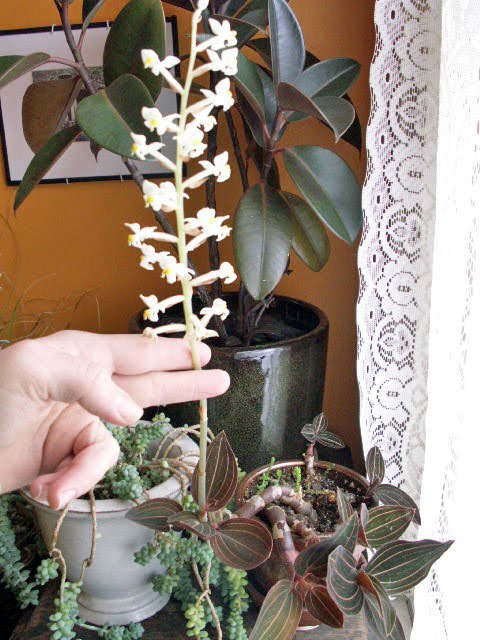
And the jewel orchid, whose flower stalk keeps growing along the curtain, meshing in with the white lace. Here it's being held upright so it can be seen:
And then there are the sneaky flowers that are blooming in the attic. My attempts at forcing dormancy in the chilly attic have achieved mixed results... but this abutilon megapotanicum seems fairly happy with its surroundings, even if it is a bit faded in color:
And the euphorbia is convinced that early spring is upon us:
From forced dormancy, we'll go to forced bloom... and close with a few shots of the gorgeous orchid I got from a coworker for my birthday last week:
The lighting in my office is atrocious, but I think that you can still tell how electric the color is on this phal. To see what's lighting up other gardeners' lives this Garden Bloggers' Bloom Day, visit Carol at May Dreams Gardens!
Subscribe to:
Posts (Atom)