I'm sure that there are some downsides to having a west-facing house. The wind whips against my front door something fierce in the wintertime, and the late afternoon sun beats down on the porch every summer. But having some amazing garden backlighting is definitely one for the "pros" list.
I've tried to take advantage of this location by planting some warm-toned foliage to add fire and sizzle to the garden as viewed from the porch. Here are a few views of the first of my current favorite garden spots... the little tapestry of texture and color around the Japanese maple:
Even the glowingest of the photos above doesn't really do this area justice. The peach-y and jewel-red heucheras, along with the Japanese maple leaves, just seem to beam their own bright lights as the sun goes down. A few other plants throughout the garden do the same, like this purple ninebark that looks like glowing embers with some backlighting, but is more of a flat purple from above:
The front yard heucheras all have a fiery glow, it seems, but the bronze carex buchanii both lights up and grounds the eye all at once:
I've shown photos before where the sea kale, stipa tenuissima, and 'Purple Knockout' salvia lyrata all gleam, too... but when they disappear in the shade, the flat colors and contrasting textures still provide a lot of interest:
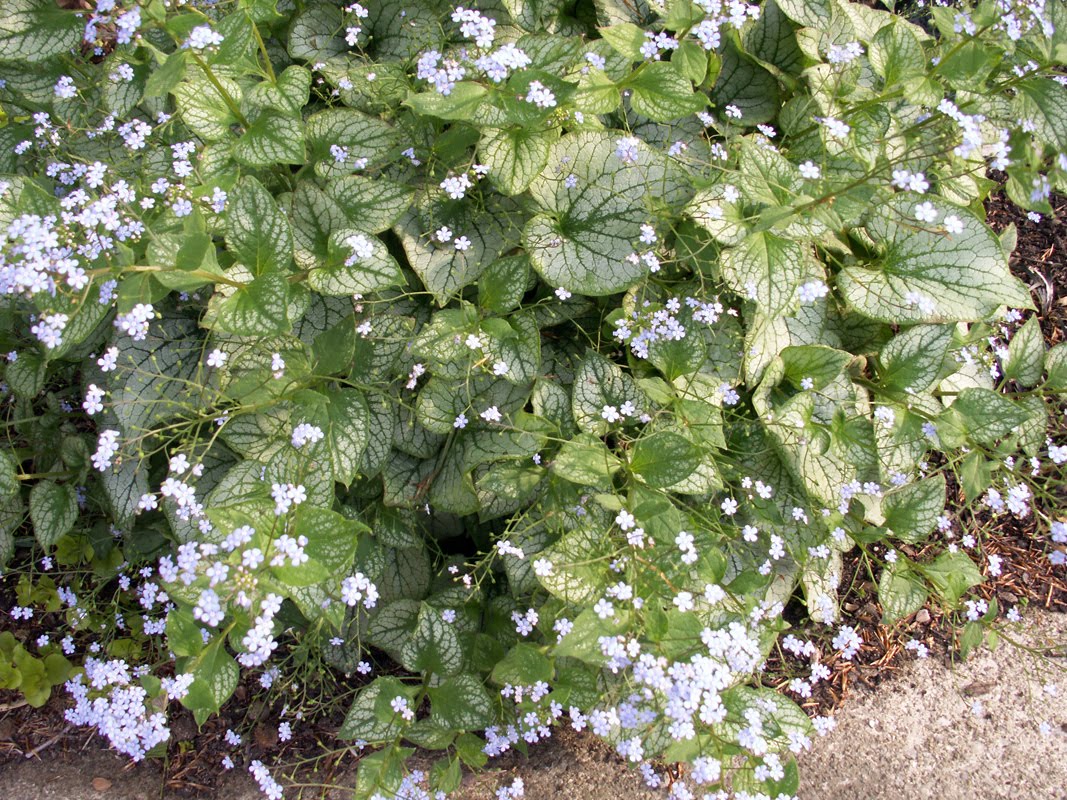
Heading to the backyard, evening light means flat color, as you see with this 'Looking Glass' brunnera and 'Dawn' hosta:
Although some plants have somewhat twisty foliage that picks up a little bit of backlighting, and casts interesting light patterns, all at once:
And of course you can always turn around, back toward the house, to get some good backlit shots in these gardens:
But the flat evening light really deadens a few areas of the garden, like the "Blackberry jungle" we're approaching here:
Viewing this photo is kind of like seeing a garden photo in black and white. My first thought was, "Wow, there is almost zero interest here with all of this fine texture!" (Okay, no... that was probably my second thought. I'm pretty sure that my first thought was actually, "YAY! I'm going to have so many blackberries this year!" :) I think that I need a few more large-leaf plants, like the 'Sagae' hosta you see in the corner here, behind the 'Caradonna' salvia:
Or at least some plants that have finer texture but a relatively strong form, like the chives that are getting ready to bloom in front of the arching blackberry:
Even these would not be so impressive, though, if not for the fact that they were planted en masse, in a straight line that echoes their own lines. But you lose that linear echo when you just look at them from above:
Ah, well, there's not much to be done with that area right now. So let's move on to more successful combinations, like the one in my other current favorite garden spot. Behold the back end of the grape arbor:
Yeah, I know, it doesn't look like much more than a whole lot of fence on first sight, does it? But I really like the light-and-dark play of the evening sun in this area. And I recently trashpicked a chandelier that will be painted in a crazy bright color and hung in the empty visual space here. The grapes will eventually grow over to that side of the arbor, too. For now, though, you need to look down for the visual interest:
And I adore the huge leaves of the 'Sum and Substance' hosta, especially as a counterpoint against the delicate-looking painted ferns and the leptinella that meanders between the recycled sidewalk stone pieces that make up the arbor floor. In reality, all of these plants back here are tough as nails... so it amuses me that it looks so lush, cool, and restorative.
The ruby tones of the orach pick up the veining of the painted ferns, as well as the burgundy color of the arbor stain. There are also some 'Copper King Strain' trumpet lilies nearby that have pinkish buds and a pinkish orange streak on the back sides of their petals--the orach matches it very well. As you can see, this "mountain spinach" is a rampant reseeder... but it's hard to mind that when you can "weed out" the poorly placed seedlings for dinner. (They really do taste like spinach.)
Edible or ornamental, tough or delicate, sunny or shady.... what are some of your favorite garden spots in the late spring? Some links to posts that show your favorites would be appreciated for later reading, once the sun goes down! (But for now... time to get back outside and PLANT! 'Tis the season!)
Tuesday, May 25
Garden Update: 2 Surprises, 2 Jobs and 1 Experiment
Two Surprises:
This week's garden cleanup/planting spree has so far yielded two very happy surprises, both in the form of returning plants! Check them out:
My emerging 'Sparkling Burgundy' Eucomis, from Plant Delights.
Most eucomis are said to be hardy to around zone 8, but PDN is very good about posting little notes like "at least," "possibly colder," "maybe colder, with good drainage," etc., on their plant listings. These notes are based on the feedback of customers who have tried to bend the usual zone rules on a given plant, and encouraged me to buy a 'Sparkling Burgundy' to try in 2008. I'm always pleasantly surprised when it returns... so maybe this will be the year it finally blooms for me, too?!
Pineapple Sage, salvia eleagans, sprouting up between tulip bulbs.
This one may be a returner, or it may be a seedling--I have no idea. Either way, I'm delighted to have pineapple sage in my garden again, without having to replant it. I'm equally glad that I found it before the little herb pot of pineapple sage that I had set aside at the garden center came home with me!
Two Jobs:
But it's been an unusual year. It's not quite Memorial Day yet, and I already have a few garden chores finished. The entire driveway bed has been cleaned up for months, I managed to plant lettuce on time for the first time EVER, and there's even a single happily planted--cage and all!--tomato ('Sungold') growing in a pot on the driveway. All that progress gives me hope that the next two tasks that I am posting about may actually be completed this year. You can see both of them in this picture:
Task #1:
I really need to repoint the brick on my front porch. Not all of it, but there are two places where the facade brick has chipped off... look on the right side of the column at the base of my front porch steps, third row down from the capstone, for an example. (Luckily, I have both of those brick pieces.) There are also a few places where there are deep gouges in the mortar that should be filled.
I've been reading up on repointing old brick, and back when this porch was initially made they would have used a soft mortar instead of the concrete we use now... and this softer mortar flexes better with the softer old bricks that were made before the 1930s. Interestingly, you can use hydrated lime (yes, the same stuff that some gardeners use to sweeten the soil!) to recreate a similar mortar. And since both of the bricks that popped out were in spots that had been previously repointed with cement, I think that I'm going to go the lime mortar route instead.
Task #2:
Also in the photo above, you can see how worn my poor lions look! The once-smooth black paint has numerous spots of wear from their years out in the elements, guarding my house. It took me a long time to come to terms with having to share my abode with these beasties, but now I love them and want them to look nice--and so, the lions require a fresh paint job. The only question is, what color? Hmm...
One Experiment
One thing that I love about working part-time at the garden center is that I get to talk with other gardening geeks. I think I've mentioned the guy who grows pumpkin vines on his lawn, artfully rearranging them after every mow. But the everyday people--the ones from whom I get things like lemon thyme vinaigrette recipes, and the idea to make pesto with sage and walnuts instead of basil and pine nuts (fabulous with thinly sliced apple and onion on a chicken sandwich)--are the ones who really make me happy.
So when a lady with whom I had been having an on-and-off conversation about various herbs, and who I had decided must be some sort of herbal goddess, mentioned that bay laurel does so much better in the ground here, I jumped on that. "What do you mean? It's not hardy here," I asked. She said that no, it wasn't, but that she gets so many more leaves on her ground-planted bays than she does on her container-planted one. No matter what sort of container she uses.
I'm not sure what I think about this idea, but... well, I've decided to do a little experiment to see whether this is true. So check out my two potted bay laurels, which appear on the steps in the lion photo that I posted above:
Both of these bay laurels were purchased at the same time, grown in the same conditions, and have been in identical clay pots since 2008. They are both approximately the same height, although the one on the lower step (planted with some dichondra way back in its infancy, as you can see) is maybe a little scrawnier. That scrawnier plant is the one that I am going to grow in the ground, and the slightly fuller one will be my "control" plant. I can't wait to see how this one pans out--hopefully, some of my foodie friends might be delighted with generous giftings of bay laurel at Christmastime this year!
Well, I was going to post a few gratuitous photos of the rest of the gardens... but that will have to wait for tomorrow instead. Have a good night, everyone!
Tuesday, May 18
May 2010 Foliage Follow-Up
Yet again, I'm late... but here's my Foliage Follow-Up for May 2010. I'll keep it short and sweet, though, with many picture but few words.
Sea kale is always a star in the front garden. I love the way it echoes the crinkles of the purple lyreleaf sage that sprouted below it here:
And how it combines with the blue tinges on the variegated iris, and lavender:
More blue foliage, first a blue-green on the emerging sedum:
And then a different lavender, contrasting with the dark purple elderberry foliage:
Similar colors, but very different leaf shapes mean a more subtle contrast. Here, 'Sagae' hosta and blackberry foliage:
A gold-and-green hosta, name unknown, with the golden foliage of 'Sweet Kate' spiderwort:
More subtle contrast, this time with the same plant form but one standout color:
Form makes for subtle contrast, too. Here, the vertical, fine-textured green chive foliage adds interest at the feet of the blackberry:
The last of the subtle contrast photos. Golden lemon balm next to the foliage of my red currant:
And golden oregano picking up the golden veins of the 'Ivory Prince' hellebore it underplants:
Golden oregano provides a little more drama in other areas of the garden. Here with 'Northern Halo' hosta and Japanese maple:
And here with a stepping stone (in the spot where the dog tends to pounce, when she sees another dog walking on the street) and the bronze-leaf carex buchanii:
Golden thyme is another pretty contrast herb. Here, with sprouts of red orach, silene flowers, last year's beech leaves, and a few tips of fallen asparagus:
More of the red orach--it's a prolific reseeder, but when you can eat the seedlings you pull, that doesn't seem to be so bad. Especially when the seedlings look so lovely with Japanese painted fern:
And 'Sum and Substance' hosta, too. That's sedum album (top) and leptinella (lower) between the stones under the grape arbor:
The large-leaf hostas are often really pretty with purple foliage. Here's another unnamed hosta with 'Frosted Violet' heuchera planted next door:
Actually, they look pretty with heucheras in general, I think. Here's another unnamed hosta (might be 'Lakeside Shore Master'?) with various peach-leaf heucheras temporarily planted nearby:
I said temporarily because those will likely get potted up into planters later in the spring. This beauty, however, stays put all year round:
And that concludes my Foliage Follow-Up for May 2010. I hope that you forgive me its lateness--and its length! It's just so hard to pick only a couple of things to showcase in May, when the foliage is so fresh and beautiful in the garden. :)
For more foliage delights, check out Pam's Foliage Follow-Up Post... and don't miss other garden bloggers' posts, too, linked in the comments there at Digging!
Sunday, May 16
A (Late, and Early) Garden Bloggers Bloom Day - May 2010
I'm a day late in posting my Garden Bloggers' Bloom Day roundup (hosted by the lovely Carol of May Dreams Gardens)... which is in stark contrast to how EARLY so many things have bloomed this year!
Last year, I was showing off a lot of tulip combos, and made note that my daffodils, red currants, blueberry, pulmonaria and tree peony were all in full bloom. The currents have had berries now for weeks, and most of the rest of my 2009 May bloomers that are blooming for the May 2010 GBBD are mostly on their way out:
A few things things appear to be right on schedule for their May bloom. "Who cares about all of those extra days of warmth we've been enjoying," they seem to ask. I wonder if the nighttime temperatures maybe have more of an effect than the daytime temps on these blooms? Here are the right-on-time plants:
A few things are just a few days ahead of their 2009 bloom cycle, but in a good way. It's kind of fun to see some of them make a bloom day post for once, instead of blooming in the "no man's land" of time between GBBDs:
And there are a few brand-new-to-my-garden bloomers, too. This list includes:
'Samobor' geranium, 'Chocolate Chip' ajuga, my blue woodland phlox, and some of the small carex are in bloom. A very few other May 2009 bloomers have inexplicably not yet begun their show--including culinary sage and chives.
To see what's blooming in other parts of the world, visit Carol's Garden Bloggers Bloom Day post for May 2010. And with that, I'm off to sneak in just a little more gardening before the sun goes down!
Last year, I was showing off a lot of tulip combos, and made note that my daffodils, red currants, blueberry, pulmonaria and tree peony were all in full bloom. The currents have had berries now for weeks, and most of the rest of my 2009 May bloomers that are blooming for the May 2010 GBBD are mostly on their way out:
The last lonely blueberry flower, with white allium and woolly thyme in the background.
What's left of the blooms on the tree peony. Doesn't this stripped-down flower look embarrassed about all of the shattered petals that lie at her feet?
Brunnera 'Jack Frost' blooms are on the wane. The younger 'Looking Glass,' which was newly planted last year, is just beginning.
A few things things appear to be right on schedule for their May bloom. "Who cares about all of those extra days of warmth we've been enjoying," they seem to ask. I wonder if the nighttime temperatures maybe have more of an effect than the daytime temps on these blooms? Here are the right-on-time plants:
My lovely Loni and the adoring Sweet Woodruff at her feet.
Various heuchera are in bloom/bud.
Lamium are also blooming in various parts of the garden. Above: 'Purple Dragon'
Bergenia flowers--they were all in full bloom at this time last year, but about half are finished already.
A few things are just a few days ahead of their 2009 bloom cycle, but in a good way. It's kind of fun to see some of them make a bloom day post for once, instead of blooming in the "no man's land" of time between GBBDs:
'Ivory Queen' Allium--only a week ahead of its 2009 cycle.
The stolen passalong variegated iris from my grandma's garden.
Passalong large purple allium from my friend (and hairdresser extraordinaire) Allison.
'Black Beauty' elderberry blooms just beginning to open.
My inherited rhododendron, which is now completely covered in blooms.
My blackberry, also now completely covered in blooms (YUM!) but just starting in the photo above.
And there are a few brand-new-to-my-garden bloomers, too. This list includes:
Flower stalks from the red cabbage that I forgot to harvest last year. They're so lovely that I think I'm going to do late harvests, and allow the second year plants to seed, every year!
'Black & Blue' salvia guaranitica. I usually buy this too late, and plant it even later, to get much of a show. That will be different in 2010!
'Samobor' geranium, 'Chocolate Chip' ajuga, my blue woodland phlox, and some of the small carex are in bloom. A very few other May 2009 bloomers have inexplicably not yet begun their show--including culinary sage and chives.
To see what's blooming in other parts of the world, visit Carol's Garden Bloggers Bloom Day post for May 2010. And with that, I'm off to sneak in just a little more gardening before the sun goes down!
Sunday, May 9
Loni: My Garden Beauty
I know that I gush about a lot of a few plants on occasion. I could wax poetic for hours on the delights of the oakleaf hydranges, heucheras, and sedums, for example. But few other plants inspire the delight that my lonicera sempervirens, a honeysuckle native to the U.S., does.
This plant has a beauty and presence in the garden that few other plants can boast. With such a vivacious personality, you know it was only a matter of time before she became one of the few plants I tend to acquire a proper nickname. "Honey" seemed too sweet... but I remember watching M*A*S*H with my mom when I was a kid, and Loni Anderson played the blonde bombshell (with brains and a big heart, to boot) on a show that came on right after M*A*S*H. So "Loni" seemed a much more fitting name for my garden beauty:
I occasionally take some of Loni's longest limbs and weave them in and out of the tops of the pickets. Even without my help, she drapes herself elegantly along the fenceline:
My favorite way to view her is backlit. In the morning, when I look out my picture window, she is backlit by the morning sun. In the slanted light just before sundown, she smolders:
Even the leaves look amazing, with their blue-green shades in flat light, and the bright green glow that pops out with a little backlighting:
And on top of all that? She's easy to grow, and doesn't require a fuss. In fact, she's so perfect that you wonder what all of the other plants must think of her... and determine that even though they probably all WANT to hate her, and are a little bit envious, they can't help but love her, too.
A final warning: This will not be the last Ode to Loni on my blog. The number of blooms waxes and wanes throughout the summer, but... well, in spite of being a vine, Loni is not really a wallflower. She isn't afraid to strut her stuff, and the show often lasts until the first frost. Expect even more pictures as the show goes on!
Subscribe to:
Posts (Atom)