Showing posts with label grasses. Show all posts

Sunday, June 17

Garden Bloggers Bloom Day - June 2012


I have to admit, I'm late for Garden Bloggers Bloom Day more often than I'm on time. Usually, I have good intentions, and start planning to try to fit in a GBBD post around the 10th... but miss the deadline anyway.  This month?  I just flat out missed the date!  I literally looked at my cell phone this morning and then said out loud:  "Oh my gosh, it's the SEVENTEENTH! I totally missed Garden Bloggers Bloom Day--AND the Foliage Follow-Up!"


At least the plants are blooming right on cue.  Well, the oakleaf hydrangea might be a tad bit early, but the ponytail grass and the salvia lyrata are pretty much on time, anyway.  And the presence of as-yet-unplanted flats of summer annuals confirms (sadly) that it's still mid-June at my house:


'Bonfire' begonia is nearing the end of its first flush of blooms on the north side of the front porch:


While bright red snapdragons are just starting to bloom in the backyard.


Drumstick alliums are just getting started now, too, but it's odd to see the lighter purple of verbena bonariensis already in bloom behind them:


I feel like the verbena usually doesn't start putting on a show until later--at least July--in a normal year. And it's odd to have a June Bloom Day without the appearance of my 'Zweiweltenkind' goatsbeard, which started blooming in earnest right after the May edition and it browned and done right now.  So I guess that the legacy of our mild winter lives on through June!

Also blooming in my yard right now:

'Summerwine' yarrow, 'Chubby Fingers' sedum album, various red sedum, 'Purple Dragon' lamium, 'Caradonna' salvia, (the last of the) sea kale, a few hosta, lonicera sempervirens, clematis jackmanii, culinary onions, 'Sweet Kate' spiderwort, 'Black Beauty' and 'Black Lace' elders (because I cut them back so late in the spring), 'Grosso' lavender, horehound, Meyer lemon, 'Blue Daze' evolvulus.

For more of what's in bloom all around the world, visit Carol's Garden Bloggers Bloom Day roundup, here.

Sunday, August 30

Signs that Autumn is Just Around the Corner: Critters, Sedums & Locks

A turtle made of found objects soldered together by a friend; my cracked pot of hens & chicks seemed the perfect thing to slip into the wheel to complete his shell. See the orange pyracantha berries--already!--in sprays behind him?

I love autumn; it's my favorite season of the year, from the rich smells of decaying, earthy leaves and acrid, smoky bonfires to the glorious last blazes of color in the garden. Once the calendar hits August, I usually start thinking fall. I look forward to pulling out sweaters for brisk walks, plan for a visit down to the local apple orchard, and vigorously rid the house of summer's whirlwind mess the way that most people do spring cleaning months earlier.

But this year... well this year, I'm just not ready yet for fall! Maybe that's because I've been so busy (I made only 19 posts in all of 2009 so far? Yikes!) or maybe it has more to do with the fact that summer seems to have forgotten us this year. Either way, the signs of an impending autumn are undeniable... and I'm not particularly happy about finding a lot of them in my garden this weekend.


A ladybug by the same friend, made out of an old pipe cap and some other spare parts. I am seeing less ladybugs, and many more grasshoppers and other "late summer" bugs, in the garden these days.

For one thing, the 'Matrona' sedum that I love in every other stage but bloom... is blooming. I know that many people have asked in the comments about why I don't keep it from blooming, or replace it with something else. Two reasons: 1) I love the dried flowerheads. 2) The bees love the blooms!

I tried to count the bees on one of my two 'Matrona' plants today, and I was up in the 30s before I lost track of the number!

My summer-flowering sedums, like 'Fuldaglut,' 'Red Dragon,' and 'Voodoo' are all spent. Some are coloring up nicely, and still look full, but the ones that get a bit of shade--like the one below--start to look scraggly at this time of the year:


A couple of sedums are still in bud, though. Here's a variegated (unnamed, bought at a plant sale, but probably sedum alboroseum) one that prefers a bit of shade:

Sedum alboroseum (I think) nestled in with horehound at the base of sorghastrum nutens 'Sioux Blue'

And here's the sedum that I showed in my bloom day post, still nestled up against the warm brown of the nearby rock:

Sedum cauticola 'Lidakense'

By the way, if I ever do get rid of 'Matrona' it will be to replace them with more of this wonderful sedum that I bought last year from Plant Delights as 'Hab Gray' sedum telephium:

Sedum telephium (bought as 'Hab Gray') with a 'Sky Pencil' Japanese holly, red cabbage and blue fescue in the background

I'm kind of convinced that I have something different, though, because Tony Avent's notes on 'Hab Gray' say that you can expect "clusters of pink flowers"... and these are more of a yellow flower. That's perfect for me, so I'm not complaining! Also notice in the photo above how the flower buds continue all the way down the stems--very nice.

And as if that wasn't quite enough, check this out:

'Maybe Hab Gray' (as I think of it) sprouting up amongst the cutback stalks of drumstick allium

Awww... it's a little baby! In fact, I have at least 6 of these little guys sprouting up within 3-4 feet of my 'Hab Gray,' and that's fine with me. I'll be transplanting a few of them to various spots around the Lock Garden next spring, assuming they overwinter okay. (They're so little, and none of them will hurt anything where they are now, that I'm leaving them alone until spring.)

Speaking of the Lock Garden, I finally got it weeded, mulched and cleaned up. That's another sign that autumn is just around the corner--I always save this area for last, since very few edibles are grown here and the plants that do reside in "the locks" are tough cookies. Some areas are filling in very nicely already:

Sedum sieboldii, 'Metallica Crispa' ajuga, silene, 3 kinds of thyme, a self-seeded blue fescue and some random baptisia foliage in the lock garden.


A close-up of the sedum, silene, ajuga, and thyme--which is the beautiful 'Clear Gold' from Mulberry Creek--meshing together underneath one of the metal industrial shelves that serve as "bridges."

A few of the plants, like this lavender thyme, were a little too happy and needed to be cut wayyyy back. You can probably tell by the way his branches are draped that I chopped about half of the plant out toward the bottom of the lock:


Cutting back thyme (and other herbs) is always an enjoyable job, but this garden will need some "real" work within the next year, though. Where the clumpier sedums reside, the sides of the locks have caved in a bit, burying some of the stone that I culled (with permission) from work) to line the lock. Their roots aren't vigorous enough to hold the soil in place the way the roots of the thyme and creeping sedums do:


And I still have some framing and pebbling (technical term... ;) to do under the shelves that are either fully or partly resting on the ground. Here's one of the frames--made from cedar, and filled in with pebbles and a small sedum album that I love and let wander a bit--that I built last year:


That frame is a simple one, so the 2-3 identical ones that I need to make for the land part of the pathway should be easy. The shelves that partly hover above the ground will not be so easy. I will have to artfully construct two separate boxes--one for each end--for shelves like these:

Two of the "bridges" over locks in the Lock Garden that will need box ends to support them. The bridge in the foreground is over the sedum/silene/thyme/ajuga combo shown above. That's part of my asparagus bed (which is beneath a small 'Himrod White' grape arbor) falling onto the pathway on the left, and self-seeded blue fescues on the right. The second bridge goes over two different types of blue-leaf sedums.

I imagine that I will either need to shore up the end of the frame that abuts the plants in the lock with stone (or maybe a full plank of cedar?) before I can pebble them, to make sure that the pebbles stay where I want. It will definitely be an engineering job, but once the frames and pebbles are in place they will stay there for a long time... only the blue shelves get lifted off of the frames and stored in the garage for the winter.

I'm trying not to panic just thinking about how much I still want to get done in the garden this year--not to mention the need to finish my fence painting, too! And I don't have very much time.... after all, autumn appears to be just around the corner. :(

Friday, August 3

Natives, Grasses

Much has been written lately about the benefits of using native plants. I love the idealism and energy of many of those who champion natives, and the idea that natives are a good source for the "right plant" to put in a certain place in your garden makes sense. After all, if a plant is predisposed to living in your soil and climate, you won't be spending a lot of time and effort working to make it happy.

On the flip side, gardening is inherently artificial and I firmly believe that even if you use all natives you will not have a truly "natural" garden. From an artistic standpoint, there are some natives that I feel are not particularly garden-worthy, and some nonnatives that I would hate to do without. And then there is the slippery slope of defining what exactly qualifies a plant as native.

Not every plant labeled "native" is indigenous to my state. Many plants that are Ohio natives, like the gorgeous trillium grandiflorum that grows wild in the woods behind my parents' house, would not be happy in my poor, sandy soil on the Lake Erie shore. Some garden cultivars of popular plants could be a cross between a native parent and a nonnative cousin--or a cultivars of a native plant that was developed in another country. So which plants qualify as native and which ones fail the test? There are many shades of gray in this complex issue.

My personal response has been to try to follow a pragmatic use of natives. I try to keep natives in mind and if it makes sense both practically and aesthetically to use a native, I do. If a nonnative is a better fit and is not potentially invasive, I have no qualms about choosing it instead. And so my garden spans the spectrum between natives and nonnatives, as you see in the second picture. A German-bred cultivar of our lovely native switchgrass, panicum virgatum 'Rotstrahlbusch,' peaks out behind a decidedly exotic 'Wyoming' canna and mingles with an amaranth whose seed was used by Native American tribes in the American Southwest.

Some U.S. natives that I find particularly enjoyable and easy to work into the garden are the native grasses. Bill over at Prairie Point often shows gorgeous pictures of these in their native habitats, and several recent shots featured schizachyrium scoparium--much easier to refer to by its common name, little bluestem. (Call me a chicken, but even with a little help from Fine Gardening Magazine I would never try to pronounce that in front of anyone who knew botanical Latin!)

Bill mentioned in the accompanying post that he wasn't sure why more gardeners didn't use little bluestem as an ornamental. I wholeheartedly agree, as the cultivar 'The Blues' is a stunner in my garden. Carefree blue foliage that deepens to reddish pink in the fall, relatively drought tolerant, fine in full or part sun--not much to complain about there!

Here you see one of my two 3-plant clumps of little bluestem. This one lives on the southeastern corner of my house where it gets full sun until about 2pm. Behind it is a pyracantha that I am beginning to train against the wall and beside it is the same clump of canna that you see in the switchgrass picture above.

At 2 years old they have not yet reached their mature height of 3-4 feet, but already they provide a nice vertical line in the garden. These fine-textured verticals soften the potentially jarring transition between the harsh line of the 2-story house the wide garden bed next to it.

One last native grass that I adore is Indiangrass, sorghastrum nutans. I was initially intrigued by the hue of the blades on 'Sioux Blue,' but it was the inflourescences that made me go back to Bluestone Perennials and order two more this spring. (You can see these in the very first picture at the top of this post.) They glowed golden in the setting sun from late summer on, with the color reminding me of glittering fields of wheat back home.

In this picture, you see the oldest and tallest of my three plants with its new neighbors: lilium, chocolate eupatorium, 'Regina' heuchera, horehound, a variegated sedum, purple leaf clover and a patch of 'Crow Feather' tiarella. The sorghastrum was chosen for this shallow "driveway bed" because it has a relatively slim profile compared to other grasses of similar height, like miscanthus. The two newer 'Sioux Blue' are evenly spaced along a 20 foot stretch of this same bed in an effort to give the area some repetition and help me avoid that bitty look.

I do have a few other U.S. native grasses on my radar for future consideration. Next year I want to reseed my back yard with a lawn of blue grama grass now that High Country Gardens put that on my radar, and there is a lovely new cultivar of little bluestem called 'Blaze' that features dark orange fall foliage... but I admit that I also hope that my clumps of the bronze carex buchanii, which hails from New Zealand, grow enough to warrant dividing next year.

Saturday, January 27

In Defense of Dead Plants


I have been reading with interest several web forum and blog posts about the issue of cleaning up your garden in the winter. Many gardeners--more than I would have anticipated--have confessed that they can't stand seeing dead plants in their garden at all. Some cut the plants down as they die, others do their garden cleanup in one fell swoop in the fall or early winter.

On the one hand, I can understand this compulsive cleanliness. On the other, I really feel that neat-as-a-pin gardeners may be missing out on a whole lot of winter interest. "A plant is only worth growing if it looks good when it is dead," says Piet Oudolf as quoted in Noel Kingsbury's recent book, Seedheads in the Garden. He was apparently half joking, but why not at least leave up those plants in your garden that don't turn to mush at the first sign of cold? Especially if you live in a climate where a quarter or so of every year is taken up by the monotonous grey/brown/white of winter.

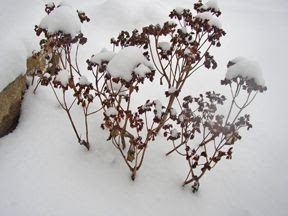
Dead plants -- especially umbellifers, like bronze fennel, and those with sturdy skeletons like tall sedums, echinacea purpurea, and eryngium yuccafolium -- can collect interesting dabs of snow on their dried seedheads and other horizontal surfaces. Thin, brittle stems and bunched dried flowers on a background of soft white snow can give the effect of a lovely ink drawing right in your garden.

The worst plants to cut back too early, IMHO, are the grasses. Unlike the stick-straight architectural plants, the grasses contribute much-needed movement to the winter garden. They always remind me of the life hidden beneath the snow as the tips of their blades move to and fro in the winter winds.

(As Henry Mitchell noted, "I do say it takes very little to convince a a gardener he will make it right into spring." For me, all it takes is a few swaying grasses.)

Even those plants that are not much to look at during the winter... well, at least give you something to look at during the winter! I forget that I still have hollyhock foliage until the snow melts and the smallest of its rounded leaves pop jauntily back up into the air. I mentally tell the artemisia that it really needs a haircut when I walk past it, but I wouldn't want to cut it back in the fall and miss the way the melting snow falls through its fanned branches in small clumps.

Check out this picture of my back garden bed. Had I cut back everything I was supposed to at the "prescribed" time, here's what would be left in terms of plant life: The rhododendron in the back, the beginnings of an espaliered firethorn against the wall, and the clump of kniphofia foliage in the front.

Since nothing was cut back, the view includes little bluestem, 'Rotstrahlbusch' switchgrass, miscanthus zebrinus, and a rose bush whose upper leaves must be frozen onto the plant at this point. When there's not 4 inches of snow on the ground, you can also see groundcover sedums, the aforementioned hollyhocks, some young lady's mantle, dried Siberian iris foliage, some dead licorice plant clumps and the silvery stems of Russian sage (they disappear against the snow but show up aginst the mulch.)

As it is, I'm upset that I did cut back most of my bronze fennel, foxgloves, 'Hillside Black Beauty' bugbane, asclepias tuberosa, and verbena bonariensis. After checking out the gorgeous arrangements that Craig at Ellis Hollow put together this fall with the dead parts of such plants, I now have plans of my own. I can't wait to harvest dried material next October for a lush--but yes, very brown--Thanksgiving centerpiece.

Now that I think about it, maybe I need to plant some more Northern sea oats... and this may just give me the excuse that I was looking for to try out phlomis russeliana, too...

Tuesday, January 23

Taking Some Pride in My Lions


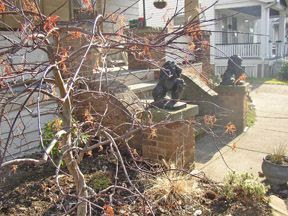
The first time I saw this house, my realtor and I both giggled at the lions "standing guard" on top of the pedestals at the base of the front steps. Front and center, they were the only bold, black features in a sea of brick, beige, and darker beige.

At that time, the small flower beds on either of them were buttoned up with retaining walls that were 2-3 blocks high. Combined together, the message conveyed was that this house (or at least its owner) took itself very seriously.

I loved the house and bought it anyway, fully intending to remove the lions and replace them with something more welcoming. Abundant, overflowing planters, perhaps. The retaining wall blocks came down quickly and groundcover sedums took their place as edging. I realized that the lions were not going to be evicted as easily, however, when two very strong guy friends--one of whom would later become my boyfriend--couldn't even get them to budge.

The lions may be relatively new to my house (according to one neighbor, they were put in around 2001) but they are fairly old. Based on the mark each one bears, they were poured in the early 1950s. I have a healthy respect for anything that is older than me, and a sledgehammer seemed like an unworthy end for such a noble guard anyway. So I did what any frustrated but sane person would do: I decided to ignore them until a good solution presented itself.

The lions quickly became a punchline amongst my friends, who knew how much I disliked them. I was surprised when I realized this spring that new plantings around the lions have softened their presence and made them more livable. The addition of a bed in front of the sidewalk and the use of darker foliage in the front yard beds makes them take a step back visually. They no longer seem in-your-face in the way that initially irked me.

I admit that I have lately gone to greater lengths to make these lions look more at home. Lions are obviously not native to my sandy shores of Lake Erie, so I am amusing myself by creating a little faux habitat for them. To anyone else, my front garden beds just happen to incorporate a bunch of funky grasses... but when I see the grasses swaying in the wind, I like to imagine that my lions are enjoying their own little piece of stylized Erie shore savannah.

You might have already guessed that these guys are growing on me. In my defense, they have been invaluable in terms of directing people who are coming to visit me--not to mention how they help me find my own home on a daily basis.

So while they still are not anything that I would have picked out for myself, and I am a long way from choosing nicknames for these guys... well, I am no longer plotting their demise or relocation, either. I will leave their ultimate fate to the house's next owner, whoever he or she may be.