I got a chance to play with the new digital SLR from work this week. Since I need to learn how to use it, I figured that taking a few pictures in the garden would be my best bet. After all, I've photographed the garden so often that it should help me gauge my skills with the new camera, right?
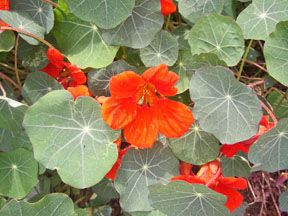
Well, I learned two things. First, that the camera goes way beyond my point-and-shoot experience, and I am going to need to read a book so I can get the most out of its capabilities. And two... that my nasturtiums are finally blooming! These late-planted 'Moonlight' climbing nasturtiums never did scramble up the chainlink fence like they were meant to, and honestly I had forgotten about them. It was a fun surprise to see them peeking out of a pile of beech leaves.
 Those leaves were trying to hide a few other things, too, like the last of the toad lily flowers but I found them anyway. And I was happy to see the white-edged ajuga I planted nearby (and then promptly forgot to water) peeking through the leaves as well. (Whew.)
 There's no hiding the blooms on my brave little alpine strawberries, which line the driveway and provide groundcover around some ornamental grasses and raspberry bushes there. I am unlikely to get any more juicy berries, but the sweet little white flowers are refreshing. And I did enjoy the sweet-tartness of two strawberries (and one raspberry) bursting on my tongue last week. Small fruit ripening in November... amazing.
 Not so good-tasting are the acid-yellow leaves of the incorrectly named 'Golden Delicious' pineapple sage. I enjoy chewing on flavored herbs while I walk the garden, so on a whim I tried these one day in August... bleeeech. It was like chewing plain old unflavored leaves--and rough leaves, at that! It's very pretty, but I feel that if a plant is supposed to be edible it really ought to have a taste, like my reblooming 'Hopi Red Dye' amaranth. (Which tastes like spinach.) So I may go back to the plain old pineapple sage that I usually grow.
 Flowers are still going in the front yard, too. Here you can see exactly why you shouldn't necessarily plant nicotiana sylvestris in a highly visible part of your garden: the leaves, flower stems, and flowers attract bugs, and their stickiness traps the bugs that come around to visit. The nighttime scent is amazing, though, so I'm planting them on a less obvious corner of the porch next year.
 Last but not least, all three of my 'Paprika' achillea are absolutely covered in flower stalks and buds! The first blooms of this reflowering bent the stalks over into the sedum and heuchera, as you see here. The exact colormatch of the heuchera leaves and the 'Paprika' flowers was not really planned--I don't particularly like actual "matching," either in the garden or in my wardrobe--but it looks okay enough together, I suppose. Dark purple leaves elsewhere in the bed and the visual weight of the nearby rock keep it from being "too sweet" for me.
 The sum total of what's in bloom today in the garden is as follows:
Perennials:
- digitalis parviflora (wimpy rebloom)
- unnamed purple toad lily
- miscanthus 'Zebrinus'
- 'Caradonna' salvia
- 'Paprika' yarrow
- chasmantium latifolium
- lavender ('Munstead,' I think)
- 'Hameln' pennisetum (almost done)
- 'Ozark' everbearing strawberries
- 'Canby Red' raspberry
- 'Lightning Strike' tricyrtis
- zauschneria latifolia var. etterii
- panicum virgatum 'Rotstrahlbusch'
- passalong silver-leaf lamium
- 'Walker's Low' catmint
- sedum sieboldii
- sedum cauticola 'Lidakense'
- hakonechloa macra 'Aureola' and 'All Gold'
- Japanese anemones 'Party Dress' and an unknown pink (possibly 'Robustissima')
- echinacea 'Merlot'
Annuals:
- 'Moonlight' climbing nasturtium
- nicotiana sylvestris
- 'Golden Delicious' salvia eleagans
- red snapdragons
- 'Hopi Red Dye' amaranth
- 'Huntington Carpet' rosemary
- 'Koralle' upright fuchsia
- bronze fennel
All in all... much more than I expected for mid-November, especially after a few light frosts! In fact, it looks more like October around here, with some trees sporting green leaves and the oakleaf hydrangea just starting to color up finally. I wonder if our extremely late snow over Easter weekend is responsible for shifting the whole growing season back a few weeks. Anyone know if that could still be possible? Maybe not, but I feel like it should take some of the blame--er, credit!
**Edited to add: I was remiss to not mention this originally (excited about my nasturtiums--sorry!) but Garden Bloggers' Bloom Day is the brainchild of Carol over at May Dreams Gardens. On the 15th of every month, garden bloggers post about what's growing in their neck of the woods... click here to visit Carol's November post and scroll through the comments to see who else has posted their bloom list!
- lavender ('Munstead,' I think)
- 'Hameln' pennisetum (almost done)
- 'Ozark' everbearing strawberries
- 'Canby Red' raspberry
- 'Lightning Strike' tricyrtis
- zauschneria latifolia var. etterii
- panicum virgatum 'Rotstrahlbusch'
- passalong silver-leaf lamium
- 'Walker's Low' catmint
- sedum sieboldii
- sedum cauticola 'Lidakense'
- hakonechloa macra 'Aureola' and 'All Gold'
- Japanese anemones 'Party Dress' and an unknown pink (possibly 'Robustissima')
- echinacea 'Merlot'
Annuals:
- 'Moonlight' climbing nasturtium
- nicotiana sylvestris
- 'Golden Delicious' salvia eleagans
- red snapdragons
- 'Hopi Red Dye' amaranth
- 'Huntington Carpet' rosemary
- 'Koralle' upright fuchsia
- bronze fennel
All in all... much more than I expected for mid-November, especially after a few light frosts! In fact, it looks more like October around here, with some trees sporting green leaves and the oakleaf hydrangea just starting to color up finally. I wonder if our extremely late snow over Easter weekend is responsible for shifting the whole growing season back a few weeks. Anyone know if that could still be possible? Maybe not, but I feel like it should take some of the blame--er, credit!
**Edited to add: I was remiss to not mention this originally (excited about my nasturtiums--sorry!) but Garden Bloggers' Bloom Day is the brainchild of Carol over at May Dreams Gardens. On the 15th of every month, garden bloggers post about what's growing in their neck of the woods... click here to visit Carol's November post and scroll through the comments to see who else has posted their bloom list!