I admittedly have only gone through three of them so far, but here is my standard procedure for dealing with Plant Delights catalogs:
1) Leaf through it page by page, checking out specific plants that catch my eye, careful to keep any drool from hitting the paper.
2) Start at the beginning and read each entry thoroughly. Appreciate some of Tony Avent's humor, roll my eyes at others of his jokes that aren't even a close miss. Circle plants that I would love to buy--to make this cut, they have to be a good fit for my garden both practically and aesthetically.
3) Go back through again, figuring out which plants I would actually buy at the prices listed--to make this cut, the plants have to actually have a specific opportunity (potential spot) in my garden as well.
4) Repeat step 3 until I have an order that is financially manageable.
Right now, I'm only through step #2 so I thought it would be fun to tally up what I would be spending at PDN this year if my yard and my wallet were both limitless. You ready for the total? $1077. YIKES! Damn those cool hellebores. And toad lilies. And grasses. And cannas. And... well, let's just say that I must have good taste. And that Plant Delights (and several other places, like High Country Gardens) would love to have me as a customer if I ever won the lottery.
Sunday, January 28


Saturday, January 27
In Defense of Dead Plants
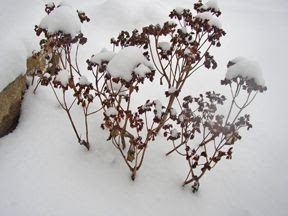
I have been reading with interest several web forum and blog posts about the issue of cleaning up your garden in the winter. Many gardeners--more than I would have anticipated--have confessed that they can't stand seeing dead plants in their garden at all. Some cut the plants down as they die, others do their garden cleanup in one fell swoop in the fall or early winter.
On the one hand, I can understand this compulsive cleanliness. On the other, I really feel that neat-as-a-pin gardeners may be missing out on a whole lot of winter interest. "A plant is only worth growing if it looks good when it is dead," says Piet Oudolf as quoted in Noel Kingsbury's recent book, Seedheads in the Garden. He was apparently half joking, but why not at least leave up those plants in your garden that don't turn to mush at the first sign of cold? Especially if you live in a climate where a quarter or so of every year is taken up by the monotonous grey/brown/white of winter.
Dead plants -- especially umbellifers, like bronze fennel, and those with sturdy skeletons like tall sedums, echinacea purpurea, and eryngium yuccafolium -- can collect interesting dabs of snow on their dried seedheads and other horizontal surfaces. Thin, brittle stems and bunched dried flowers on a background of soft white snow can give the effect of a lovely ink drawing right in your garden.
The worst plants to cut back too early, IMHO, are the grasses. Unlike the stick-straight architectural plants, the grasses contribute much-needed movement to the winter garden. They always remind me of the life hidden beneath the snow as the tips of their blades move to and fro in the winter winds.
 (As Henry Mitchell noted, "I do say it takes very little to convince a a gardener he will make it right into spring." For me, all it takes is a few swaying grasses.)
Even those plants that are not much to look at during the winter... well, at least give you something to look at during the winter! I forget that I still have hollyhock foliage until the snow melts and the smallest of its rounded leaves pop jauntily back up into the air. I mentally tell the artemisia that it really needs a haircut when I walk past it, but I wouldn't want to cut it back in the fall and miss the way the melting snow falls through its fanned branches in small clumps.
 Check out this picture of my back garden bed. Had I cut back everything I was supposed to at the "prescribed" time, here's what would be left in terms of plant life: The rhododendron in the back, the beginnings of an espaliered firethorn against the wall, and the clump of kniphofia foliage in the front.
Since nothing was cut back, the view includes little bluestem, 'Rotstrahlbusch' switchgrass, miscanthus zebrinus, and a rose bush whose upper leaves must be frozen onto the plant at this point. When there's not 4 inches of snow on the ground, you can also see groundcover sedums, the aforementioned hollyhocks, some young lady's mantle, dried Siberian iris foliage, some dead licorice plant clumps and the silvery stems of Russian sage (they disappear against the snow but show up aginst the mulch.)
As it is, I'm upset that I did cut back most of my bronze fennel, foxgloves, 'Hillside Black Beauty' bugbane, asclepias tuberosa, and verbena bonariensis. After checking out the gorgeous arrangements that Craig at Ellis Hollow put together this fall with the dead parts of such plants, I now have plans of my own. I can't wait to harvest dried material next October for a lush--but yes, very brown--Thanksgiving centerpiece.
Now that I think about it, maybe I need to plant some more Northern sea oats... and this may just give me the excuse that I was looking for to try out phlomis russeliana, too...
Wednesday, January 24
New Garden Blog Directory


Leave it to Stuart down at Gardening Tips 'N Ideas to create a great new gardening blog directory. As if the clickable map that allows you to find garden blogs by geographic area isn't enough fun, he's built a garden blog search engine, too.
I did a test search for "salvia" and was rewarded with pages of results. All came not from random webpages or plant retailers, but from the posts within the blogs that make up the directory. How cool is that? You can pick the brains of your fellow garden bloggers without having to interrupt their winter catalog dreaming or spring planting.
The only thing that I can think of that would immediately improve this directory is the addition of more webpages. So if you're a garden blogger and you're reading this, click on over and get yourself added!
One shortcut to this for U.S. bloggers: Stuart will ask for your latitude and longitude in order to properly place your little dot on the map. I found a free address verification page that will give you those coordinates once you type in your street address. For the record, I garden at 41.4727 Degrees North, 81.7919 Degrees West.
Tuesday, January 23
Taking Some Pride in My Lions

The first time I saw this house, my realtor and I both giggled at the lions "standing guard" on top of the pedestals at the base of the front steps. Front and center, they were the only bold, black features in a sea of brick, beige, and darker beige.
At that time, the small flower beds on either of them were buttoned up with retaining walls that were 2-3 blocks high. Combined together, the message conveyed was that this house (or at least its owner) took itself very seriously.
I loved the house and bought it anyway, fully intending to remove the lions and replace them with something more welcoming. Abundant, overflowing planters, perhaps. The retaining wall blocks came down quickly and groundcover sedums took their place as edging. I realized that the lions were not going to be evicted as easily, however, when two very strong guy friends--one of whom would later become my boyfriend--couldn't even get them to budge.
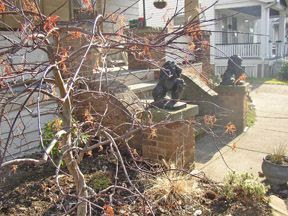 The lions may be relatively new to my house (according to one neighbor, they were put in around 2001) but they are fairly old. Based on the mark each one bears, they were poured in the early 1950s. I have a healthy respect for anything that is older than me, and a sledgehammer seemed like an unworthy end for such a noble guard anyway. So I did what any frustrated but sane person would do: I decided to ignore them until a good solution presented itself.
The lions quickly became a punchline amongst my friends, who knew how much I disliked them. I was surprised when I realized this spring that new plantings around the lions have softened their presence and made them more livable. The addition of a bed in front of the sidewalk and the use of darker foliage in the front yard beds makes them take a step back visually. They no longer seem in-your-face in the way that initially irked me.
 I admit that I have lately gone to greater lengths to make these lions look more at home. Lions are obviously not native to my sandy shores of Lake Erie, so I am amusing myself by creating a little faux habitat for them. To anyone else, my front garden beds just happen to incorporate a bunch of funky grasses... but when I see the grasses swaying in the wind, I like to imagine that my lions are enjoying their own little piece of stylized Erie shore savannah.
You might have already guessed that these guys are growing on me. In my defense, they have been invaluable in terms of directing people who are coming to visit me--not to mention how they help me find my own home on a daily basis.
So while they still are not anything that I would have picked out for myself, and I am a long way from choosing nicknames for these guys... well, I am no longer plotting their demise or relocation, either. I will leave their ultimate fate to the house's next owner, whoever he or she may be.
Tuesday, January 16
Snowy Path to Nowhere
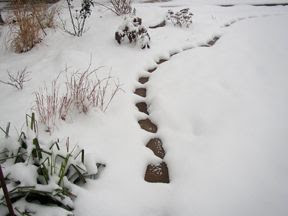
This isn't really a snowy path to nowhere, it's the edging of my garden bed. I took a picture of it before either I or the dog trampled the snow in the backyard to capture its peaceful, simple beauty.
More snow-covered pictures to come... but not tonight. Tonight I am tired from a long, rough day at work, and tonight my boyfriend is home from a long, tough visit to New Jersey. Tomorrow is another day.
Subscribe to:
Posts (Atom)