Monday, January 15

Sometimes I'm Fickle


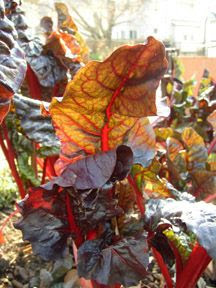
I believe that my love affair with 'Rhubarb' Swiss Chard was pretty adequately documented on this blog, with many pictures posted of light playing through its thick, red-veined leaves.

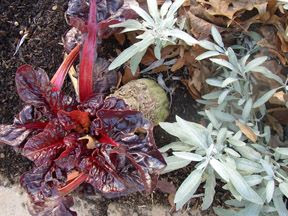
Swiss chard is a member of the beet family, which easily explains the thick root that you can see at the base of the plant in the second picture. In fact, it is a variety of beta vulgaris (the same species as the common beet) that was cultivated over the years specifically for the taste of its leaves rather than the flavor of its root.

While researching Swiss Chard, I found quite a few named cultivars and mixes. 'Rhubarb,' 'Ruby,' 'Bright Lights,' 'Rainbow,' and 'Fordhook Giant' are all well-known names in the world of chard.

I briefly considered purchasing seeds for 'Fordhook Giant' or another white-veined variety to grow in my 2007 garden for a change of pace. In visiting the websites of seed vendors, however, a completely different option presented itself: Kale

It sounds like I'm a little fickle here, I know, but it really is a smart option. I love Swiss Chard sauteed in garlic and olive oil, with a little sea salt... but to me there is very little taste difference between Swiss Chard and beet greens prepared that same way. I know that I am going to be planting beets again this year, so why not branch out in the greens department? I find kale to have a very different taste.

A few extra searches confirmed that I have to grow kale in my garden this year, if for no other reason than to enjoy the interesting texture it provides. Now the only question in my mind is this: From an aesthetic standpoint, which way should I go? Lacinto Blue? Or Redbor? Anyone have input on the aesthetic value of kale?

Friday, January 12

In Appreciation of the Quiet Workhorses

Sometimes we all get blinded by the garden showstoppers--you know, the plants to which odes are written and for which admiration societies form. When I first started gardening, many of the truly lovely but comparatively quiet "workhorse" plants flew under my radar. Tiarellas were one such casualty, aided by the fact that an attempt at establishing a groundcover patch of tiarella wherryi in the shady side yard at my old house failed.

I rediscoverd tiarellas when I worked part-time at a local garden center in 2005 to help pay off my "divorce debt." The person who ordered our shade perennials had purchased a number of different cultivars, including 'Crow Feather,' 'Iron Butterfly' and 'Lacquer Leaf.'

As I occasionally deadheaded the shade perennials, I admired the tiarellas for their toughness--and their beauty of both leaf and form. When I read that they offered interesting winter color as well, I decided that I needed to bring some home with me. I liked all of the cultivars above, but for some reason was especially drawn to 'Crow Feather.'

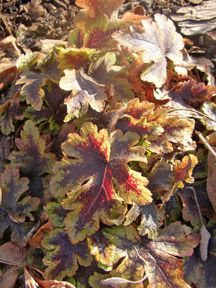
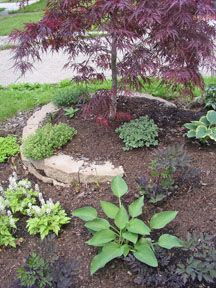
As you can see from the first picture, 'Crow Feather' has interesting winter color. The purple blotches on the interior of the leaf turn darker purple, red, or reddish brown and the green outer leaf margins turn various shades of yellow through rust.

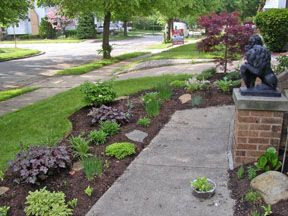
In fact, winter is when I seem to appreciate tiarellas the most, but that is probably only due to lack of competition. As you can see from the other two pictures, they are pretty handsome plants in the spring when they wave bright bottlebrush flowers above their leaves. (The tiarellas are in the lower left corner of the closeup, and under the Japanese maple at the far end of the sidewalk in the other picture. In both, you can spot their white flowers.)

If deadheaded regularly, they continue to flower intermittently through the summer and fall. Other than deadheading, the only maintenance they need is the occasional deadleafing--similar to the treatment of heucheras. I will admit that I might be a little more vigilant about deadleafing the tiarellas, but that is only because I enjoy the scent of the leaves when they are crushed or pulled. It is very fresh-smelling, like celery and cucumber combined.

My tiarellas were in their "creeping" year during 2006, so I expect to see some "leaping" out of them this year. They are even worthwhile in their slow years, however, so I hope to never be without them in the garden.

How about the rest of my fellow garden bloggers? Any quiet plants that you love and want to give a shoutout to? With plants like these, it seems that they need either a cheerleader or a publicist to make a splash... and although I've adjusted my radar, I want to make sure I'm not missing anything particularly garden-worthy.

Sunday, January 7

Diagnosis: Bad News


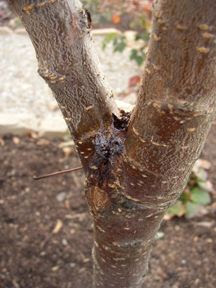
While out taking pictures in my garden in December, I noticed some very disturbing areas of gumming on my young Bing cherry tree. I took a few pictures of the affected areas, and began to research.

You know how it goes when you're researching diseases. First you have yourself convinced that you are looking at the worst case scenario. Then you go through a phase where you search for symptoms that would prove your ailment is something extremely treatable that can be mistaken for the more dire consequence.

Time and even more research seems to bring answers. The more I read about bacterial canker on cherry trees, the more I became convinced that this is what is afflicting my Bing--not an "easier" problem like winter injury.

The final nail was driven when I read about "dead bud disease," which is a manifestation of bacterial canker that causes buds to die back on the spurs in the spring. I saw that happen on this cherry (but only this cherry) in the spring of 2006, but had attributed the dieback to a very late freeze. I am pretty confident that this tree must have been infected already when I brought it home from the nursery in late 2005.

Some sites say that you can cauterize the cankers to help kill bacteria that live on their margins, or even dig them out with a knife. I simply am not willing to do all kinds of spraying and babying when I have such limited space in the garden--even though both my Dad and I love sweet cherries, halved and frozen--so on the first reasonably warm day I will go outside and remove it.

I do have two other cherry trees, one sour and one sweet. Neither variety is supposed to be as susceptible to bacterial canker as the Bing, and neither is showing any sign of disease. They both have resided a good distance from the Bing within my garden, so it is possible that both are still healthy.

However, if I pull out the Bing I will probably pull out the other sweet cherry regardless of its health. I only purchased it in the first place to pollinate the Bing, and I really have no other place to locate a pollinator for it except for the space where the Bing currently resides. I am very leery of planting another sweet cherry there.

Ideally, I will replace the healthy sweet cherry with another sour cherry, this one a larger variety than the dwarf 'Northstar' that I have. As for the spot where the diseased cherry was discovered, I'm still not sure. I think I need to go research elderberries, which I previously discounted for lack of space. Anyone know if the berries from those pretty dark-leaved sambucus nigra cultivars like Black Beauty make good jelly--or wine?

Thursday, January 4

The Best Laid Plans...


You might remember me bragging about how I wrested an overgrown "dwarf" willow tree out of the ground with my bare hands (okay, and a pruning saw) this past summer. After it met its deserved end, I settled a newly purchased 'Diablo' ninebark in its place.

Between then and now, the house next door was sold. I am going to be putting up a wooden privacy fence bewteen my house and this lot in the spring, so I didn't worry too much about what their plans would be for their backyard. I knew that the house had been slow to sell in part because there was no garage or other covered parking, but I figured that the fence would take care of hiding whatever was built in the backyard.

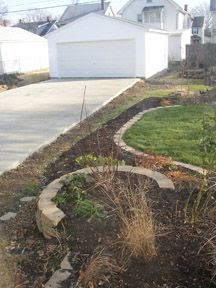
Well... maybe not. This shot was taken out of my large picture window in the dining room. In the foreground you see the aforementioned ninebark, snuggled within the confines of a circle of retaining wall block alongside some hellebores and ajuga.

When I am in the backyard at ground level, a 6ft. tall fence will provide plenty of privacy. When looking out my picture window, however, the stark white garage will be very distracting as it peeks over the fence. And peek over the fence it will--see the grey fence at the back of my lot for a height comparison. That fence is 6ft. tall painted spruce stockade.

Luckily, all of this happened before the ninebark had much time to settle in. It will get switched this spring with the 'Northstar' dwarf cherry tree that is currently residing midyard and has a much taller (to 10ft.) and more upright form than the ninebark. It won't help as much during the winter, but during the colder months of the year I spend more time looking to the right, at my birdfeeder, anyway.

Oh, and I forgot to mention the best part about the whole construction deal. The new owners are actually just flipping the house, and they have offered me the HUGE rock that was in their backyard as compensation for tearing up some of my grass while they put in the driveway and garage. The grass was frankly marked for death anyway, and I was trying to figure out a way to ask them if I could buy the rock off of them... so I am thinking that this is working out pretty well for me all around!

Tuesday, January 2

Seed Buying: Method and Madness

Carol over at May Dreams Gardens posed a lot of interesting questions in her recent post, titled: "Seed Buying: Method or Madness?" There were too many questions for me to answer in a mere comment--after all, I can't even keep my regular posts under two screeens--so I figured they would be best addressed here.

- Do you carefully read all of the seed catalogs sent to you and then browse the Internet to compare and contrast all the options, then decide which seeds to buy?
-
Do you order seeds from more than one seed company to save on shipping or buy from whoever has the seeds you want, even if it means paying nearly the same for shipping as you do for the actual seeds?
- Do you buy seeds from ‘bricks and mortar’ stores and get whatever appeals to you as you are browsing?

- Do you buy vegetable seeds in bulk where they scoop them out of seed bins, weigh them and put them in hand-marked envelopes?

My answers to the above are: Yes, both, yes and... I wish! When I buy seeds from catalogs and Internet sites, I tend to be very careful and methodical. My credit card might eventually come out to finish off the sale, but it usually takes weeks if not months to get to that point.

I make lists, research what I might want to buy and who offers the varieties I want at the best prices (shipping included) and then whittle the lists accordingly. If there is a plant I really want to grow and I know I can't find its seed locally, I will pay up as long as its total cost is still cheaper than buying the number of those kinds of plants that I want in the spring.
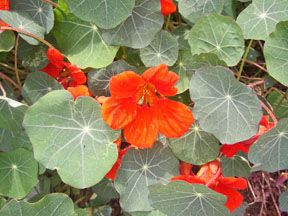
In bricks and mortar garden centers, on the other hand, I can get into real trouble. The pretty pictures, the choices... really, who can resist a whole half rack of different varieties of nasturtiums? Especially when you planted only red and dark orange varieties last year, and didn't realize how charming the buttery yellow ones were until you saw their pictures on the fronts of those packets?

- Do you buy seeds for just vegetables, or just annual flowers? Do you buy seeds for perennial flowers?
- Do you only buy seeds to direct sow into the garden or do you end up with flats of seedlings in any window of the house with decent light?


In terms of buying, I buy seeds for everything--veggies, herbs, annual flowers and perennials. I haven't sown indoors or direct sown in the garden since I discovered winter sowing. I can winter sow a lot more seeds than I have room to start indoors, and I have more control over what goes where in the garden with winter sowing than I would with direct sowing.

This winter, I am winter sowing crocosmia, echinops bannaticus, 'Apricot Sprite' and 'Apache Sunset' agastaches, winter hardy sempervivum, 'Wizard Velvet Red' coleus, stipa tenuissima and nicotiana sylvestris in addition to the usual suspects for the veggie garden. I would definitely not have the money to buy all of the plants of the above that I would like to grow--another benefit of winter sowing.

- Do you list all your seeds on a spreadsheet, so you can sort the list by when you should sow them so you have a master seed plan of sorts?
-
Do you determine germination percentage for old seed?

I wish that I had the discipline and organization to keep a spreadsheet, but I tend to rely more on intercranial information filing--which I admit isn't always the most reliable method. Maybe if I set up a spreadsheet this winter, however, I can do better at record-keeping this spring.

I probably will not do much in the way of determining germination percentage for old seed, though, unless you count chitting and then planting the sprouts. I never seem to have enough of old seed to just test a sample, and I would feel badly about wasting sprouted seed.

- Do you save your own seeds from year to year and exchange them with other seed savers?
-
Do you buy more seeds than you could ever sow in one season?
-
Do you keep all the old seeds and seed packets from year to year, scattered about in various drawers, boxes, and baskets?

I saved seeds this year for the first time, from 'Pride of Gibralter' cerinthe, digitalis parviflora, and cimicifuga/actaea. I would like to save more this year, particularly if I find some good-tasting plum tomatoes.
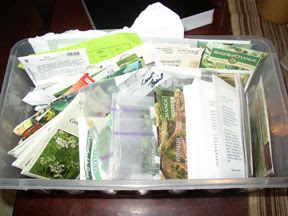
As far as buying more seeds than I could ever sow in one season and saving packets from year to year... yeah, guilty as charged. Check out what a wreck my seedbox is, and it was just cleaned up this fall! I donated a bunch of extras to fellow gardeners and a couple of gardening newbies. I also talked myself into throwing out seeds older than 2002--more because I figured that after 4 years it was safe to assume I would not bother planting them than because of any concerns about viability.

- Do you know what stratification and scarification are? Have you done either or both with seeds?
-
Do you have a fear of seeds? Some gardeners don’t try seeds, why not?
-
Do you understand seeds? I once bought seeds at a Walmart in January (Burpee Seeds) and the cashier asked me, “Do these really work? Yes, they do. “Isn’t it too cold to plant them now?” Well, yes, if you are planning to plant them outside. I don’t think this cashier grew up around anyone who gardened.


I can define the processes of stratification and scarification, and have done both. I have no fear of seeds--but then I have no fear of any aspect of life, including death.

I guess that you could say that yes, I understand seeds... but I do have to admit that I don't want them to lose all of their mystery and magic, either. I love knowing the science behind them, but would like to always appreciate the small miracle that every seed contains as well.